


Are you trying to boost your website’s traffic and improve its search engine ranking? You have probably come across different tools promising amazing results. The debate of sparktraffic vs serpseo is a common one among website owners and digital marketers. Both platforms offer ways to increase your site’s visibility, but they work very differently. Choosing the wrong one can waste your time and money, or even hurt your site’s reputation.
This guide will walk you through everything you need to know. We will compare SparkTraffic and SERPSEO head-to-head. You will learn what each tool does, who it is for, and the potential risks involved. By the end, you will have a clear understanding of which strategy, if any, is right for your goals.
Key Takeaways
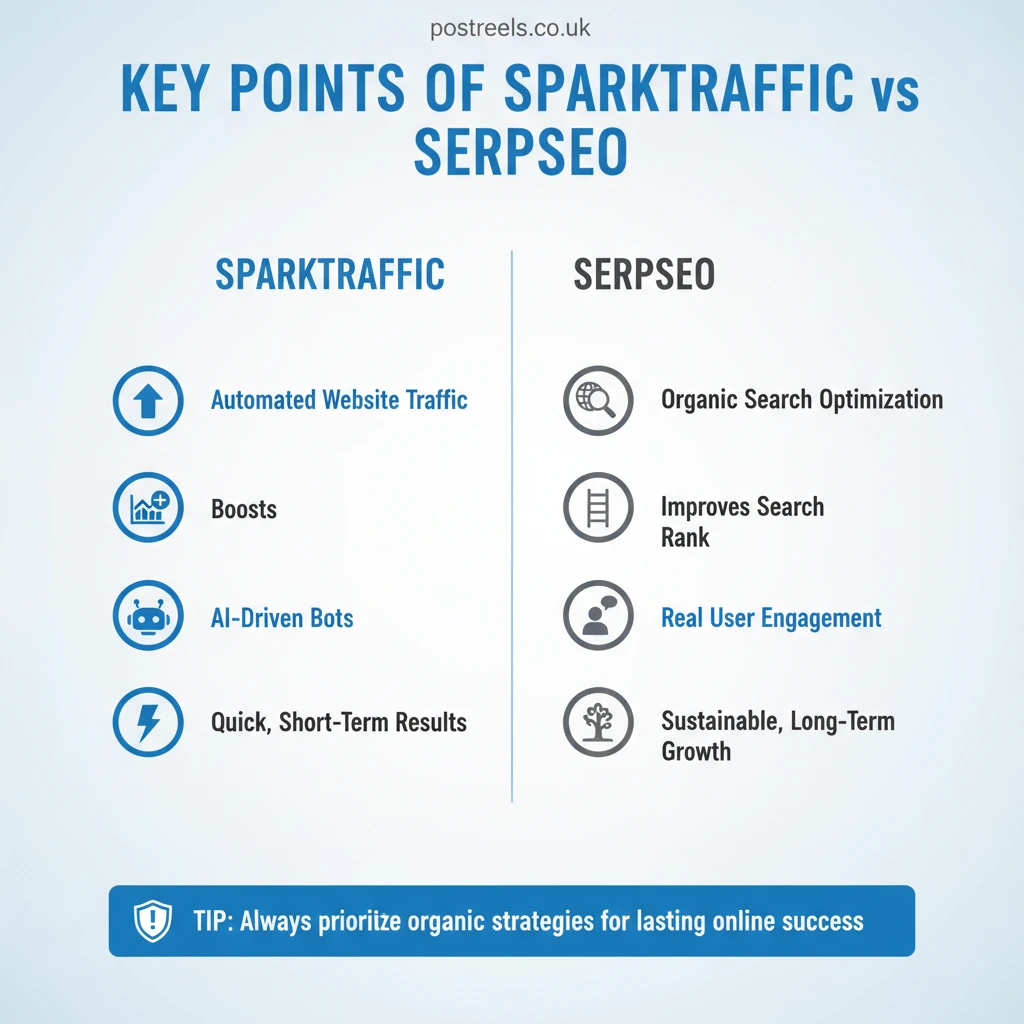
- Core Function: SparkTraffic is a traffic bot that sends automated visits to your site, while SERPSEO focuses on manipulating click-through rates (CTR) from search results.
- Best Use Case: SparkTraffic is for short-term vanity metrics, like showing high traffic numbers. SERPSEO is for testing how changes to your search snippets affect user clicks.
- Traffic Quality: The traffic from SparkTraffic is generally low-quality and automated. SERPSEO aims to simulate more realistic user behavior from search engines.
- Risk Level: Both tools carry risks. Using traffic bots can lead to penalties from Google, and manipulating CTR is a black-hat SEO tactic that search engines actively fight against.
- Long-Term Value: Neither tool is a substitute for genuine SEO strategies like creating high-quality content, building good backlinks, and improving user experience.
What Is the Main Goal of SparkTraffic?
SparkTraffic is a service that generates automated website traffic. Think of it as a traffic bot. You can buy a plan, and the service will send a specific number of “visits” to your website each day or month. The main goal is to inflate your traffic numbers quickly and easily. You can choose where this traffic appears to come from, including different countries and cities.
This can be tempting for new website owners who want to see their analytics charts go up. For example, a startup in Austin, Texas, might use SparkTraffic to show potential investors that their new site is already getting thousands of visitors. The service is straightforward: you pay for a certain volume of traffic, and it gets delivered. The visits are not from real people interested in your products or services. They are automated scripts designed to load your webpage.
How Does SERPSEO Approach Traffic Generation?
SERPSEO takes a different, more targeted approach. Instead of just sending random visits, its purpose is to influence your website’s click-through rate from Google’s search results pages (SERPs). The idea is based on the theory that a higher CTR can signal to Google that a result is relevant, potentially boosting its ranking.
Here is how it generally works: you provide the tool with your target keywords and your website’s URL. The service then uses a network of proxies or real users to search for your keywords on Google. When they find your website in the results, they click on it. This action is meant to simulate real user interest. For instance, a local bakery in Chicago might use a service like this to improve its ranking for “best croissants in Chicago.” By increasing clicks, they hope Google will see their site as a popular choice and move it higher in the search results.
SparkTraffic vs SERPSEO: A Head-to-Head Comparison
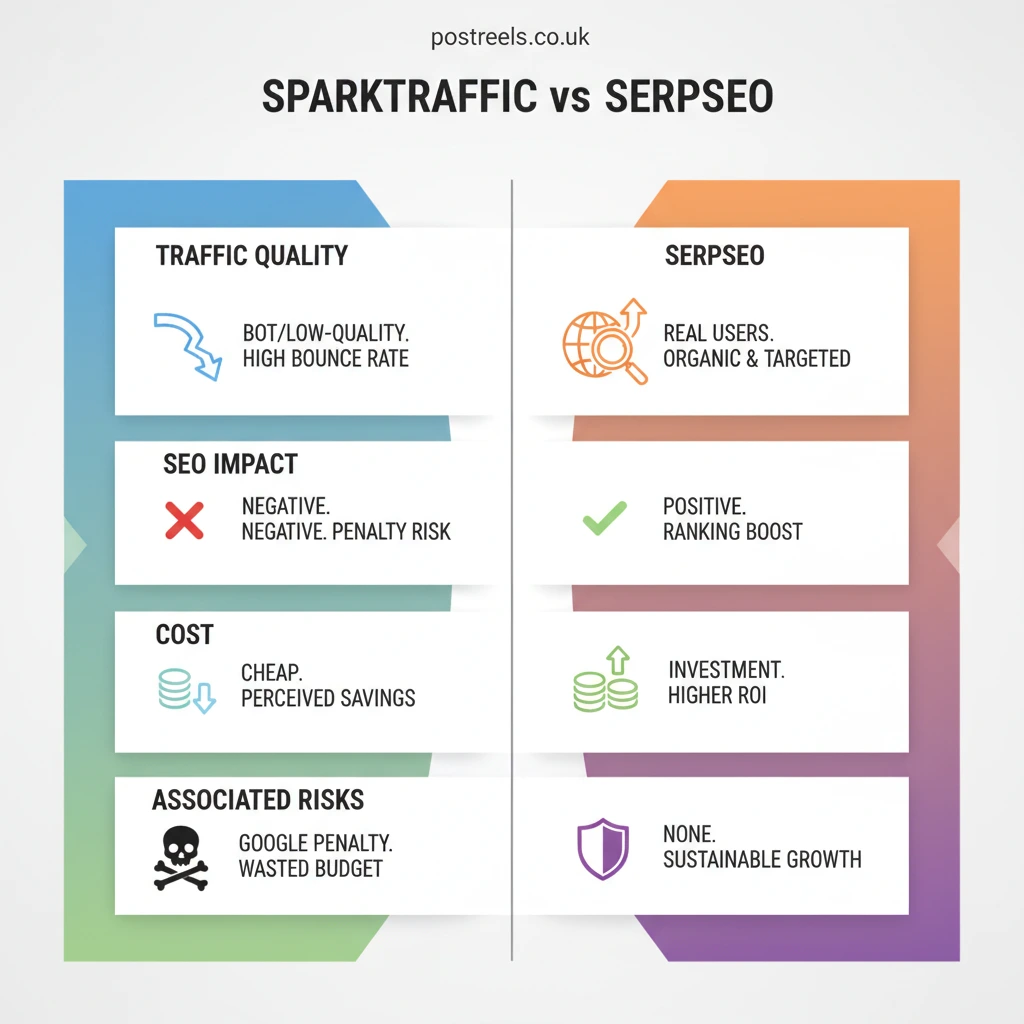
| Feature | SparkTraffic | SERPSEO (and similar CTR tools) |
|---|---|---|
| Primary Method | Automated bot traffic | Clicks from search engine results |
| Main Goal | Increase website visit volume | Improve Click-Through Rate (CTR) |
| Traffic Source | Direct, referral, or social (spoofed) | Organic search (simulated) |
| Traffic Quality | Very low (automated scripts) | Low to medium (simulated users) |
| User Engagement | Almost none (high bounce rate) | Can be programmed for longer visits |
| SEO Impact | Negative or none long-term | Potentially short-term gains, risky |
| Best For | Load testing, vanity metrics | A/B testing search snippets, risky SEO |
| Cost | Generally cheaper | Often more expensive |
| Risk Level | High (can trigger Google penalties) | Very high (black-hat SEO tactic) |
Can SparkTraffic Actually Improve Your SEO?
This is a critical question. In short, the answer is almost always no. While SparkTraffic can make your Google Analytics look impressive, this traffic has no real substance. These automated visits typically have a 100% bounce rate, meaning the “visitor” leaves immediately after landing on one page. They do not click on other links, fill out forms, or buy anything.
Google’s algorithms are incredibly sophisticated. They can easily distinguish between real, engaged users and low-quality bot traffic. Real users spend time on your site, visit multiple pages, and interact with your content. This positive user experience is a powerful ranking signal. Bot traffic does the opposite. It sends negative signals, telling Google that people who visit your site find it uninteresting. Over time, relying on such traffic can harm your rankings rather than help them. It offers no long-term SEO value.
What Are the Real Risks of Using SERPSEO?
Using SERPSEO or any other CTR manipulation tool is considered a black-hat SEO tactic. It violates Google’s webmaster guidelines, which strictly prohibit any attempt to manipulate search rankings. While some users might see a temporary boost in their rankings, the risks are substantial.
Google is constantly updating its algorithms to detect and penalize this kind of artificial engagement. If your site is caught, you could face a manual penalty. This means your site’s ranking could plummet, or it could be removed from search results entirely. Recovering from such a penalty can be a long and difficult process. Imagine a small e-commerce store in Phoenix that relies on organic traffic for sales. A Google penalty could wipe out their business overnight. It is a high-stakes gamble that is rarely worth the potential reward.
Who Should Consider Using SparkTraffic?
Despite the SEO risks, there are a few niche scenarios where a tool like SparkTraffic might be considered. It is important to understand that these are not for improving your search ranking.
- Server Load Testing: Before a big product launch, a developer might want to see how their server handles a sudden surge in traffic. SparkTraffic can simulate this environment to identify potential weaknesses.
- Vanity Metrics for Presentations: A marketer might need to present a report to stakeholders who are not SEO-savvy. Inflated traffic numbers can make a new project look successful on the surface, although this is ethically questionable.
- Ad Placement Testing: Some website owners use it to generate impressions on ad networks. However, most ad networks, including Google AdSense, have strict policies against bot traffic and will ban accounts that violate them.
In all these cases, the traffic should not be mistaken for real audience growth.
When Is a CTR Tool Like SERPSEO a Better Fit?
A CTR manipulation tool is never a “safe” choice, but some SEO professionals use them for specific, experimental purposes. The primary use is to test how changes to a page’s title tag and meta description affect its click-through rate.
For example, an SEO analyst could run a controlled experiment. They might run a campaign with one title for a week, measure the CTR, and then change the title and run it again. This could provide data on which headline is more appealing to users. However, this same testing can often be done through legitimate A/B testing tools or by analyzing data in Google Search Console without resorting to risky black-hat methods. The information gained rarely outweighs the danger of a Google penalty.
Are There Any Safer Alternatives to These Tools?
Yes, and they are far more effective for long-term success. Instead of trying to trick search engines, the best strategy is to earn your traffic and rankings. This is known as white-hat SEO.
Focus on High-Quality Content
Create articles, guides, and videos that genuinely help your audience. Answer their questions and solve their problems. A well-researched blog post is more valuable than a million bot visits.
Improve User Experience (UX)
Make sure your website is fast, easy to navigate, and mobile-friendly. A good user experience encourages visitors to stay longer and explore more pages, which is a powerful positive signal for Google.
Build High-Quality Backlinks
Earn links from other reputable websites in your industry. This tells Google that your site is a trusted authority on your topic. Guest posting, creating shareable infographics, and digital PR are great ways to do this.
Optimize for Technical SEO
Ensure your site is technically sound. This includes using proper heading structures (H1, H2, H3), having a clean URL structure, and submitting a sitemap to Google.
These strategies take more time and effort, but they build a sustainable foundation for growth that will not disappear with the next algorithm update.
Real-Life Example: The Failed Traffic Bot Experiment
A friend of mine launched an online store selling custom-made guitar pedals. He was new to digital marketing and grew impatient with the slow pace of organic growth. He signed up for a service similar to SparkTraffic, buying 100,000 visits for a month. His analytics shot up, and he was thrilled.
But then he looked closer. His bounce rate was 99.8%. His average session duration was less than one second. Most importantly, he had zero sales from this traffic. After a few months, he noticed his organic traffic for his main keywords started to drop. He had been sending strong negative signals to Google, and his rankings suffered. He eventually stopped the service and spent the next six months focusing on creating great content and building real relationships in the musician community. His traffic grew slowly but steadily, and this time, it brought in actual customers.
How to Make the Right Choice for Your Website
Deciding between sparktraffic vs serpseo—or choosing neither—comes down to your goals.
- If your goal is sustainable, long-term growth: Avoid both. Focus your resources on white-hat SEO strategies that build a real, engaged audience.
- If you need to test server capacity: SparkTraffic can be a useful, short-term tool for this specific technical task.
- If you are an advanced SEO professional conducting a risky experiment on a non-critical site: A CTR tool might offer some data, but the risks are still very high.
For over 99% of website owners, the answer is clear. The quick fixes promised by traffic bots and CTR manipulation tools are not worth the danger they pose to your website’s health and reputation. Investing in authentic growth is always the better path.
Final Thoughts
The discussion around sparktraffic vs serpseo highlights a fundamental choice in digital marketing: do you take shortcuts or build something lasting? SparkTraffic offers empty numbers, while SERPSEO offers risky manipulation. Both represent a departure from the user-focused principles that Google and other search engines prioritize.
True success online comes from providing real value to real people. Creating helpful content, fostering a great user experience, and earning authority in your niche are the cornerstones of a successful digital strategy. These methods are not just safer; they are the only way to build a resilient online presence that attracts loyal customers and stands the test of time.
Frequently Asked Questions (FAQs)
Q1: Can Google detect traffic from SparkTraffic?
Yes, Google’s algorithms are highly effective at identifying low-quality bot traffic. They analyze hundreds of signals, including bounce rate, time on site, and navigation patterns, to differentiate between real users and automated scripts.
Q2: Will using SERPSEO guarantee a higher ranking?
No. While some users may report temporary ranking increases, there is no guarantee. Furthermore, the risk of a penalty from Google is extremely high, which could erase any potential gains and severely damage your site’s visibility.
Q3: Are traffic bots illegal?
While not illegal in a legal sense, using traffic bots to generate fake impressions or clicks on ads is a violation of the terms of service for most ad networks, like Google AdSense, and can result in a permanent ban. It also violates Google’s guidelines for webmasters.
Q4: What is a better investment than buying traffic?
Investing in high-quality content creation, technical SEO audits, and a good user experience will provide a much higher return on investment. These strategies build a strong foundation for sustainable organic growth that attracts real, converting customers.
Q5: Can I use SparkTraffic just to make my new site look popular?
You can, but it is a misleading practice. This “popularity” is an illusion that provides no real business value. It will not lead to sales, sign-ups, or genuine brand engagement. It is far better to have 10 real visitors who are interested in your content than 10,000 bot visits.