


When you are looking for a tree that offers beauty without the mess, the navigator pear usually tops the list of recommendations. If you have ever walked through a well-planned neighborhood in the suburbs of Chicago or Denver, you have likely seen these beauties lining the streets. They stand tall, proud, and incredibly neat. Unlike other fruit trees that drop mushy surprises on your driveway, this variety keeps things clean and tidy.
This tree is a game-changer for homeowners who want curb appeal but don’t have hours to spend on gardening every weekend. It offers that classic orchard look with none of the typical orchard maintenance. Whether you are planting a single specimen in your front yard or lining a long driveway, understanding what makes this tree tick is the first step to a beautiful landscape. Let’s dig into everything you need to know about this resilient, stunning tree.
What Exactly Is a Navigator Pear Tree?
The navigator pear is technically known as Pyrus ‘DurPSN303’, but that is a mouthful, so most nurseries just stick to the common name. It is an ornamental pear tree, which means its main job is to look good rather than feed your family. While it is related to the pears you buy in the grocery store, this specific variety was bred for structure, hardiness, and flowers rather than fruit production.
It was introduced specifically for colder, harsher climates where other ornamental trees might struggle. If you live in zones 2 or 3—think North Dakota or parts of Canada—this tree is practically a miracle worker. It survives brutal winters that would kill a Bradford pear instantly. It grows in a nice, tight oval shape, reaching about 25 to 35 feet tall and about 12 to 15 feet wide. This upright growth habit makes it perfect for smaller urban lots where you can’t have a tree spreading out and hitting the neighbors’ windows.
One of the biggest selling points is that it is often described as “fruitless.” Now, to be totally honest with you, nature is rarely 100% predictable. Occasionally, you might see tiny, insignificant fruit that is less than an inch big, but it is nothing like the heavy crops that rot and attract wasps on other pear varieties. For the most part, you get all the beauty of white spring blossoms without the fall cleanup headache.
Why Do Landscapers Love the Navigator Ornamental Pear?
Professional landscapers are obsessed with the navigator ornamental pear for a few very practical reasons. First, it is tough as nails. In the landscaping world, a “call-back” is when a client calls to complain that a plant died, and nobody wants that. This tree is reliable. It resists fire blight, a common bacterial disease that turns pear trees black and ugly, better than many older varieties.
Second, the form is impeccable. It grows straight and uniform with very little pruning required. If you plant five of them in a row, they will likely grow at the same rate and look like a matched set. This symmetry is huge for curb appeal. It creates that high-end, manicured look that usually costs a fortune to maintain, but this tree does it naturally.
Finally, it tolerates urban conditions like a champ. Pollution, poor soil, and compacted dirt are usually death sentences for delicate trees. However, this pear tree seems to shrug it off. I have seen them thriving in median strips in busy cities and in brand-new housing developments where the “soil” is mostly construction clay. If it can grow there, it can probably grow in your backyard.
When Does the Navigator Pear Tree Bloom?
Springtime is really the main event for the navigator pear tree. Depending on where you live, usually around late April or early May, the tree transforms into a cloud of white. The flowers are clustered and dense, covering the branches so thickly that you can barely see the wood underneath. It is a showstopper that announces that winter is finally over.
The blooms appear just before the leaves fully unfurl. This timing is crucial because the green leaves don’t hide the white flowers, making the display even more striking. The show lasts for about a week or two, depending on the weather. If you get a heavy rainstorm, the petals might drop a bit sooner, creating a “snow” effect on the grass below, which is honestly just as pretty.
It is worth noting that ornamental pear flowers have a distinct smell. Some people don’t mind it, but others find it a bit strong or fishy. It isn’t usually noticeable unless you stick your nose right in the blossoms, but it is a quirky characteristic of the genus. The visual impact, however, is universally loved. It is one of the first trees to bloom, giving you color when the rest of the garden is still waking up.
What Does the Foliage Look Like in Summer and Fall?
After the flower show ends, the navigator pear doesn’t just fade into the background. It pushes out glossy, dark green leaves that look polished and healthy all summer long. The leaves are heart-shaped or slightly oval, and they have a thick, almost leathery texture that helps them resist tearing in high winds. This is great if you live in an open, breezy area.
The summer foliage provides excellent shade. Because the branching structure is dense, it blocks out a lot of sun, making it a great tree to plant on the west side of a house to cut down on cooling bills. It is not a giant shade tree like an oak, but for a patio or a small yard, it offers a perfect cool spot.
Then comes autumn, and the tree puts on its second show of the year. The leaves turn brilliant shades of yellow, orange, and sometimes red. It is like a burning torch in the landscape. While maples get all the credit for fall color, this pear tree is a serious contender. The color tends to hold on late into the season, too, keeping your yard looking vibrant even as other trees go bare.
How Do I Plant and Care for a Navigator Pear?
Planting a navigator pear is pretty straightforward, but getting it right from day one makes a huge difference. You want to pick a spot with full sun. This tree craves light. If you put it in the shade, it will grow thin and won’t flower nearly as well. It needs at least six hours of direct sunlight a day to stay happy and dense.
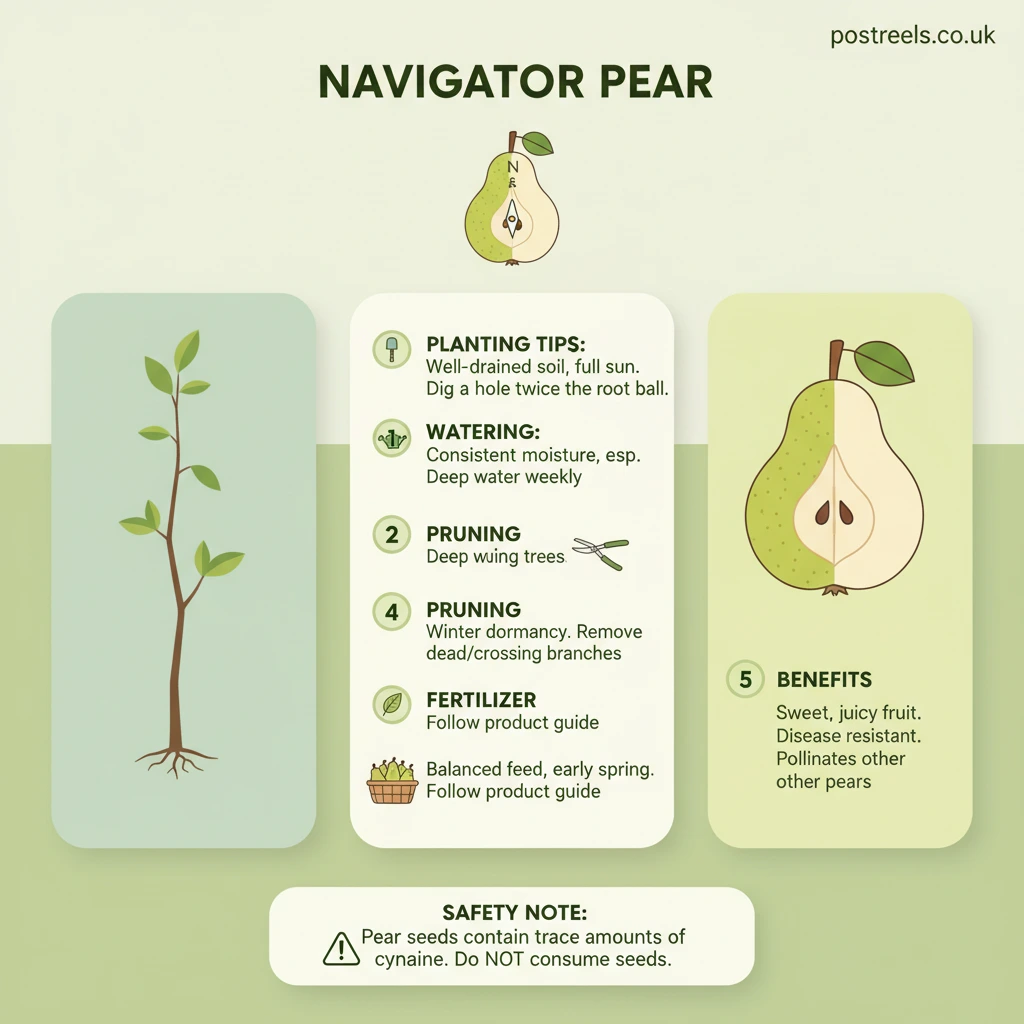
Dig your hole twice as wide as the root ball but no deeper. You want the tree to sit slightly above the soil line to prevent the trunk from rotting. Once it is in the ground, water is key. For the first year, you need to water it deeply once a week. A slow trickle from a hose for about 30 minutes is better than a quick blast. This encourages deep roots.
Mulch is your best friend here. Put a 3-inch layer of wood chips around the base, but—and this is important—don’t pile it up against the trunk like a volcano. That kills trees. Keep the mulch a few inches away from the bark. Once established, this tree is surprisingly drought-tolerant, but giving it a drink during dry spells will keep the leaves looking shiny.
Do I Need to Prune My Navigator Pear Tree?
One of the best things about the navigator pear tree is that it is low-maintenance regarding pruning. Because it naturally grows in that tidy, upright oval shape, you don’t need to fight it to make it look good. However, a little snipping now and then helps keep it healthy.
The best time to prune is late winter or very early spring, before the buds break. You want to look for any branches that are rubbing against each other or crossing. Remove those to prevent bark damage. Also, take out any dead or broken wood. This “cleaning up” helps air circulate through the canopy, which keeps fungal diseases away.
Unlike fruit-bearing pears, you don’t need to prune for fruit production. You are pruning purely for structure. If you see a branch shooting off in a weird direction that ruins the symmetry, feel free to snip it back. Just remember the rule of thumb: never remove more than 25% of the canopy in a single year.
Can This Tree Survive in Cold Climates?
If you live in the northern United States or Canada, finding trees that survive -40°F is a challenge. The navigator pear was bred precisely for this. It is rated for Zone 2, which is incredibly hardy. Most ornamental pears, like the Cleveland Select, are only hardy to Zone 5 or maybe 4.
This hardiness means the wood doesn’t suffer from “frost cracks” as easily as other trees. Frost cracks happen when the sun warms up the bark on a freezing day, and then the temperature plummets at night, causing the wood to split. The Navigator’s bark is tougher and more resilient.
It also wakes up at the right time. Some trees bloom too early and get zapped by a late frost, ruining the display for the year. The Navigator seems to have a good internal clock, usually waiting until the danger of hard frost has passed before opening those delicate white buds.
Comparison of Ornamental Pear Varieties
| Feature | Navigator Pear | Bradford Pear | Cleveland Select |
|---|---|---|---|
| Hardiness Zone | Zone 2 (Very Cold) | Zone 5 (Moderate) | Zone 5 (Moderate) |
| Tree Shape | Upright, Oval | Broad, Round | Pyramidal |
| Branch Strength | Strong | Weak (breaks easily) | Strong |
| Messiness | Very Low (rare fruit) | High (fruit drops) | Low |
| Disease Resistance | Excellent | Poor | Good |
Is the Navigator Pear Invasive?
This is a hot topic. Many older ornamental pears, specifically the Bradford pear, have become invasive nightmares in some states. They cross-pollinate with wild pears and create thorny thickets that choke out native plants. Because of this, many people are wary of planting any Pyrus species.
The navigator pear is generally considered a safer bet because it produces very little viable seed. However, no tree is completely risk-free in every single environment. In most residential and urban settings, it behaves perfectly. It stays where you plant it and doesn’t pop up in the nearby woods.
If you are concerned about local ecology, check with your local extension office. In 99% of cases, especially in colder northern climates where invasive spread is slower, this tree is a responsible choice. It provides the aesthetic benefits without the ecological guilt associated with its invasive cousins.
How Does the Navigator Pear Fit Into a Modern Landscape Design?
Modern landscape design is all about clean lines and low maintenance. The navigator pear fits this aesthetic perfectly. Its vertical, columnar habit makes it great for framing views. Planting one on either side of an entryway creates a grand, welcoming feeling.
It is also excellent for screening. Because it is dense, a row of them planted about 8 to 10 feet apart creates a privacy screen that is much friendlier looking than a fence. In the summer, you won’t see your neighbors, but you still get light and air movement.
For small backyards, it serves as a great focal point. You can underplant it with colorful perennials like hostas or daylilies. The dark green leaves of the pear tree make the colors of the flowers below pop. It provides height and structure without taking over the entire yard.
What Are Some Unexpected Search Results for Twisted Pear?
When researching pear trees or looking for local spots, search engines can sometimes throw curveballs. You might be looking for tree info and stumble upon terms like navigate to twisted pear forest city or queries about a social page like navigate twisted pear forest city nc facebook.
It turns out, “Twisted Pear” is a popular name for businesses, including taprooms and bottle shops. Specifically, there is a well-known spot in Forest City, NC. While this has nothing to do with horticulture, it shows how popular the word “pear” is in branding!
If you were actually trying to find that location, you would want to head to Main Street in Forest City. But if you are here for the tree, don’t get confused. The navigator pear tree won’t pour you a craft beer, but it will make your garden look amazing while you drink one on your patio. It’s a funny overlap in keywords, but it happens often with common fruit names!
Where Can I Buy a Navigator Pear Tree?
You usually won’t find a specialty tree like the navigator pear at a big-box hardware store. They tend to stock generic varieties. Your best bet is a local nursery that specializes in trees for your specific climate zone.
Since this tree is famous for its cold hardiness, nurseries in the Midwest and Northern Plains stock it regularly. If you can’t find one locally, many reputable online tree nurseries ship dormant trees in early spring.
When buying, look for a tree with a straight central leader (the main trunk). Avoid trees that have two main trunks splitting into a “V” shape at the bottom, as these can be weaker as they age. A healthy young tree should have smooth bark and evenly spaced branches.
How Fast Does the Navigator Pear Grow?
Patience is a virtue, but nobody wants to wait 20 years for shade. The navigator pear is considered a medium-to-fast grower. Under good conditions—meaning regular water and decent soil—it can put on 1 to 2 feet of growth per year.
This means if you plant a 6-foot whip (a young sapling), you will have a substantial-looking tree in about 5 to 7 years. It fills out quickly, too. It doesn’t stay skinny and stick-like for long. The canopy thickens up within the first few growing seasons.
Fertilizer can help, but don’t overdo it. A balanced slow-release fertilizer applied once in the spring is usually plenty. Giving it too much nitrogen can make it grow too fast, resulting in weak, snappy wood. Slow and steady creates a stronger, longer-lasting tree.
Frequently Asked Questions (FAQs)
Q: Does the Navigator Pear produce edible fruit?
A: No, not really. While it might produce tiny, hard fruits occasionally, they are inedible and not tasty. It is grown strictly for its flowers and foliage.
Q: Is the Navigator Pear tree messy?
A: It is considered a very clean tree. It doesn’t drop large rotting fruit, and the leaf drop in fall is manageable. The flower petals drop in spring, but they disappear into the grass quickly.
Q: How big does a Navigator Pear get?
A: At maturity, it reaches about 25-35 feet in height and 12-15 feet in width. It maintains a compact, upright oval shape.
Q: Can I plant a Navigator Pear near my driveway?
A: Yes, it is an excellent street or driveway tree. Its root system is generally not aggressive enough to crack concrete if planted with proper spacing (at least 4-5 feet away from pavement).
Q: How long does a Navigator Pear tree live?
A: With proper care, these trees can live for 30 to 50 years. They are longer-lived than the notorious Bradford pear because they are structurally stronger and less prone to splitting.
Q: Does it smell bad when it blooms?
A: Like most ornamental pears, the blossoms can have a distinct, somewhat musky odor. However, it is usually not overpowering unless you are standing directly under it in still air.
Conclusion
Choosing the right tree is a commitment, but the navigator pear makes it an easy one. It checks all the boxes for a modern homeowner: it is beautiful, low-maintenance, hardy, and clean. It brings four seasons of interest to your yard, from the snowy white blooms in spring to the glossy green summer leaves, and finally, the fiery autumn colors.
Whether you are in the frozen north or a bustling city, this tree adapts and thrives. It asks for very little—just some sun and a bit of water—and gives back heaps of curb appeal. If you are tired of dealing with messy fruit or fragile trees that break in the wind, the Navigator is the upgrade your landscape deserves.
So, head to your local nursery (or browse online, avoiding the confusion with the bottle shop in Forest City!) and see if this sturdy, stunning pear tree is the right fit for your patch of earth. Your future self, relaxing in its shade without a rake in hand, will thank you.