


Choosing the right path for your spiritual education is a massive decision. It feels like standing at a fork in a road where both signs point to “Enlightenment,” but the paths to get there look very different. If you have been searching online, you have probably stumbled across the debate of the University of Metaphysical Sciences vs university of Metaphysics. At first glance, the names are so similar that you might think they are the same school. They are not. They are distinct institutions with different philosophies, teaching styles, and student communities.
In this guide, we are going to break down everything you need to know. We will look at curriculum, accreditation, cost, and the overall “vibe” of each school. By the end, you will have a clear picture of which university aligns best with your personal journey. Let’s dive in and clear up the confusion.
What is the Core Philosophy Behind Each School?
When comparing the University of Metaphysical Sciences vs university of Metaphysics, the biggest difference starts with their mission. Every school has a “soul”—a driving force that shapes how it teaches. Understanding this is crucial because it determines if you will enjoy your time there.
The University of Metaphysics (UOM) is deeply rooted in the New Thought movement. It was founded by Dr. Paul Leon Masters, a significant figure in metaphysical teaching. Their philosophy often leans heavily towards “Theocentric Psychology.” This approach focuses on the connection between the individual and the Universal Mind or God. It feels traditional, almost like a lineage-based teaching. If you are looking for something that feels like a classic mystery school updated for the modern era, UOM often fits that bill.
On the other hand, the University of Metaphysical Sciences (UMS), based in California and founded by Christine Breese, takes a more eclectic approach. Their philosophy is like a vast library of spiritual knowledge. They don’t stick to just one lineage. Instead, they cover everything from shamanism and divination to world religions and consciousness studies. If UOM is a deep dive into a specific stream of thought, UMS is like swimming in a wide ocean of various spiritual traditions.
For many students in the United States, this philosophical difference is the deciding factor. Do you want a focused, singular path (UOM), or do you want a broad, diverse exploration (UMS)?
How Do the Curricula Compare Side-by-Side?
The actual coursework is where the rubber meets the road. You need to know what you will actually be reading and writing about. When we look at the University of Metaphysical Sciences vs university of Metaphysics, the structure of the classes varies significantly.
At the University of Metaphysics, the curriculum is very structured. It is designed to take you from a Bachelor’s degree all the way to a Doctorate in a specific sequence. The lessons are often shorter and focused on daily affirmations, meditation practices, and the teachings of Dr. Masters. The content is digestible and consistent. It is great for someone who wants a steady rhythm without getting overwhelmed by too many conflicting theories.
The University of Metaphysical Sciences offers a massive volume of written material. Their courses are thick with information. A single module might cover the history of a specific practice, scientific theories related to it, and practical exercises. Students often report that UMS feels more “academic” in terms of the sheer amount of reading and research required. They cover broad topics like “Energy of Money,” “Chakras,” and “Yogic Philosophy” in great detail.
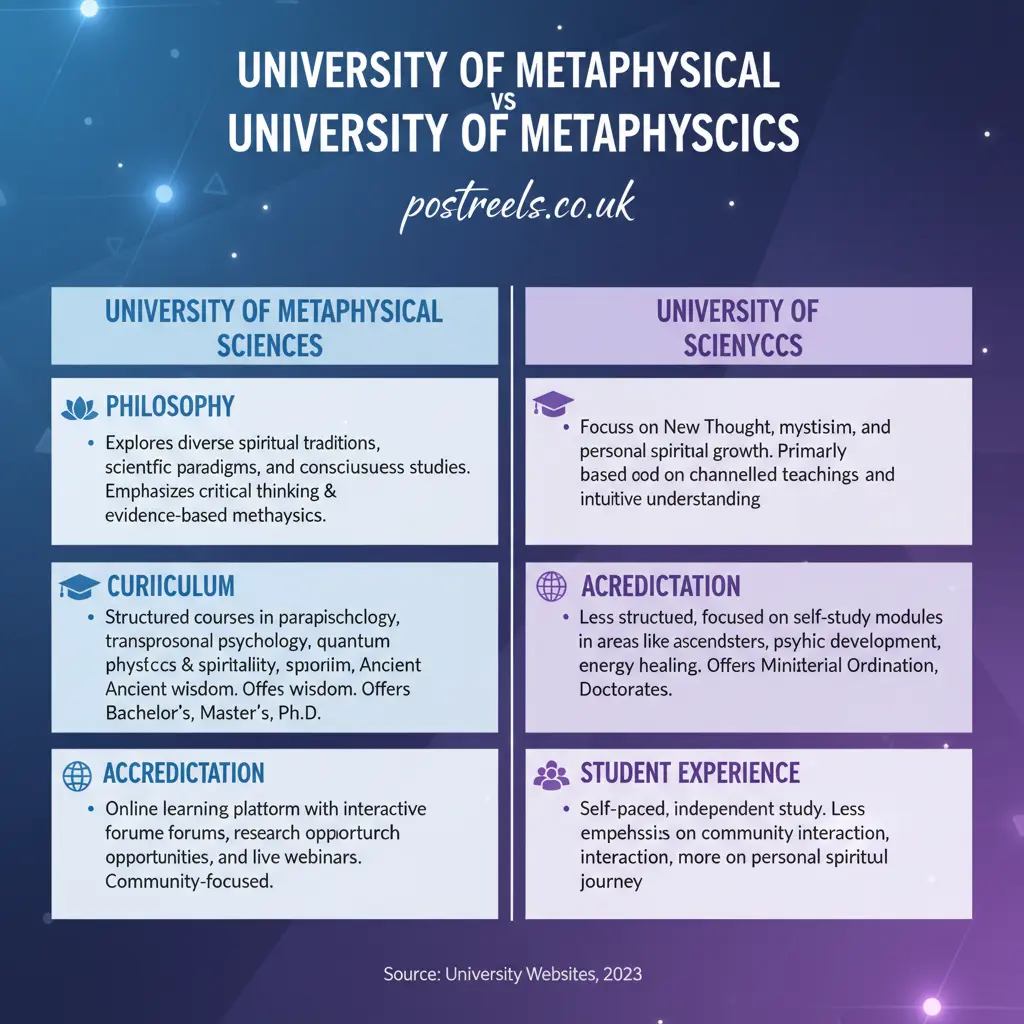
Here is a quick comparison table to visualize the curriculum differences:
| Feature | University of Metaphysics (UOM) | University of Metaphysical Sciences (UMS) |
|---|---|---|
| Focus | New Thought, Theocentric Psychology, Dr. Masters’ teachings | Eclectic, Multi-cultural, Broad Spiritual Topics |
| Format | Structured, lesson-based, heavy on audio/video | Text-heavy, research-based, extensive reading |
| Variety | Specialized and focused | Wide-ranging and diverse |
| Pacing | Self-paced but follows a strict sequence | Highly self-paced, flexible order of study |
Which Institution Offers Better Accreditation and Credibility?
This is the most common question students ask. It is also the trickiest. In the world of metaphysics, “accreditation” works differently than it does for a state university like UCLA or Yale. Neither of these schools holds “regional accreditation” from the U.S. Department of Education. This means you cannot use federal student loans, and credits likely won’t transfer to a secular college.
However, both schools have their own forms of recognition. The debate of university of metaphysical sciences vs university of metaphysics often centers on which “type” of credibility matters to you.
The University of Metaphysics is part of the International Metaphysical Ministry. They have been around for decades. Their degrees are widely recognized within the metaphysical community, especially for those wanting to become ordained ministers. If your goal is to start a spiritual center or church, their long-standing reputation is a huge asset.
The University of Metaphysical Sciences is registered with the California Bureau for Private Postsecondary Education (BPPE) as an exempt religious institution. They are also accredited by independent metaphysical accrediting agencies. Their credibility comes from the depth of their material and the success of their alumni in writing books, running retreats, and offering coaching.
Think of it this way: If you want to be a hospital chaplain, check specific requirements for your state, as neither might suffice. But if you want to open a Reiki healing center or write spiritual books, both hold weight in the holistic industry.
What is the Student Experience and Community Like?
Studying metaphysics can be a lonely journey if you don’t have a tribe. The community aspect is a major differentiator in the university of metaphysical sciences vs university of metaphysics comparison.
The University of Metaphysics has a very large alumni network because they have been operating for so long. They hold annual conventions where students from all over the world gather. These events are high-energy and great for networking. It feels like joining a large, established family. You can find UOM graduates in almost every major city in the U.S., from New York to Los Angeles.
The University of Metaphysical Sciences has a thriving online community. They utilize social media groups and online forums very effectively. Because their headquarters is also a retreat center (Starlight Ridge), they offer opportunities for in-person retreats that feel very intimate and immersive. Students often describe the UMS vibe as supportive, open-minded, and very interactive.
For example, a student from Oregon mentioned that she chose UMS specifically because she wanted to attend their specialized retreats to practice what she learned in books. Another student from Florida chose UOM because he wanted to attend the large annual convention to network with established ministers.
How Do the Tuition Costs and Payment Plans Differ?
Money matters. Spiritual education is an investment, but it shouldn’t break the bank. When analyzing the university of metaphysical sciences vs university of metaphysics, pricing structures are quite competitive but different.
The University of Metaphysics is known for being very affordable. They offer low down payments and monthly payment plans that are accessible to almost anyone. Their mission has always been to make metaphysical education available to all, regardless of financial status. You can often get started for under $100 down.
The University of Metaphysical Sciences also offers payment plans, but the total cost might be slightly higher depending on the degree package you choose. However, they provide a tremendous amount of physical or digital course material, which adds value. They often bundle Bachelor’s, Master’s, and Doctorate degrees into one package price, which can save money in the long run.
Pro-Tip: Always check their websites for the current “scholarship” or “pre-pay” offers. Both schools frequently run specials that can save you significantly on tuition.
Which Degree Programs Are Available at Each School?
You are not just taking classes; you want a degree. Both schools offer Bachelor’s, Master’s, and Doctoral degrees. But the titles of these degrees differ, which is a key part of the university of metaphysical sciences vs university of metaphysics decision.
At the University of Metaphysics, the primary focus is often on degrees like “Metaphysical Science” or “Theocentric Psychology.” The path is very linear. You usually get your Bachelor’s, then Master’s, then Doctorate in a straight line.
At the University of Metaphysical Sciences, you have a bit more variety in your focus. You can specialize in areas like “Metaphysical Counseling” or “Divinity” with different emphases. They allow for a “Ph.D.” or a “D.Div.” track depending on whether you want a more philosophical or religious focus.
Both schools require a thesis or dissertation for higher degrees. This is a chance to write about a topic you are passionate about. UMS is known for being very rigorous with its dissertation review, pushing students to produce high-quality work.
Can You Use These Degrees for a Career?
This is the big question. What can you actually do with these degrees? The answer is similar for both, but the nuance lies in the training.
In the University of metaphysical sciences vs university of Metaphysics debate, career outcomes depend on your hustle. Neither degree is a “job ticket” like a nursing degree. You don’t graduate and get hired by a corporation. Instead, these degrees empower you to build your own career.
Graduates from both schools often become:
- Life Coaches
- Spiritual Counselors
- Authors and Speakers
- Meditation Teachers
- Ministers for Weddings and Memorials
Because UOM focuses on ministry and counseling from a specific New Thought perspective, its graduates often start spiritual centers or churches. UMS graduates, having a broader education, often end up in eclectic healing arts, running retreats, or working as holistic practitioners integrating various modalities.
For instance, a graduate in Austin, Texas, uses her UMS degree to back her credentials as a holistic wellness coach. Meanwhile, a graduate in Chicago uses his UOM credentials to officiate weddings and offer pre-marital spiritual counseling.
Does the Location of the University Matter?
In the digital age, does physical location matter? Yes and no.
The University of Metaphysics is headquartered in Sedona, Arizona. Sedona is known as a global vortex of spiritual energy. Even if you study online, the fact that the school is grounded in Sedona adds a certain mystical appeal for many students. Their conventions are often held in places with high spiritual significance.
The University of Metaphysical Sciences is based in California, with a retreat center nearby. California has always been a hub for progressive spiritual movements. The vibe is very “West Coast”—open, experimental, and nature-focused.
When considering university of metaphysical sciences vs university of metaphysics, think about which energy resonates with you. The red rocks of Sedona (UOM) or the lush forests of California (UMS)? Even if you never visit, the school’s culture is influenced by its home.
What Are the Technical Requirements for Online Study?
Both universities are primarily distance learning institutions. This means you need to be comfortable with self-directed study.
The University of Metaphysics has modernized significantly. They offer a student portal where you can access lessons, listen to audio lectures, and submit exams. It is user-friendly and straightforward.
The University of Metaphysical Sciences delivers materials largely via downloadable PDFs and MP3s. You can also opt to receive physical binders of course material if you prefer reading on paper (though this costs extra for shipping). UMS is great for people who want to build a physical library of resources they can reference forever.
If you struggle with technology, UOM’s simple portal might be easier. If you want to download everything and keep it on your hard drive forever, UMS’s format is excellent.

How Do They Handle Spiritual Counseling Training?
Many people enter these programs specifically to become counselors.
In the university of metaphysical sciences vs university of metaphysics comparison, the counseling training is distinct. UOM approaches counseling from a spiritual, God-centered perspective. You learn to help clients connect with their inner divinity to solve problems. It is very effective for spiritual crisis management.
UMS approaches counseling with a broader toolkit. You might learn about “inner child work,” “shadow work,” and communication skills alongside spiritual concepts. It feels a bit more like a blend of traditional therapeutic techniques and spirituality (though it is legally spiritual counseling, not psychotherapy).
What Do Alumni Say About Their Experiences?
Reviews are telling. When you look at forums discussing university of metaphysical sciences vs university of metaphysics, patterns emerge.
UOM alumni often praise the personal transformation they underwent. They talk about how Dr. Masters’ voice and teachings helped them find inner peace. The loyalty to the school is very high.
UMS alumni often rave about the content. They talk about how much they learned about crystals, angels, world religions, and quantum physics. They feel like they got a massive education that would have taken decades to find on their own.
One common thread in reviews is that both schools require self-motivation. Nobody is going to call you to ask why you haven’t turned in your homework. You have to want it.
Are There Differences in Ministerial Ordination?
Both schools offer ordination, which allows you to legally perform weddings and offer pastoral counseling.
With the University of Metaphysics, ordination is a core part of the process early on. It is integrated deeply into their identity as a Ministry.
With the University of Metaphysical Sciences, ordination is also available and is a beautiful process, often culminating in a ceremony at their retreats.
If your primary goal is to be a minister quickly, UOM often streamlines this process effectively. If ministry is secondary to learning about obscure spiritual topics, UMS treats it as a valuable option but perhaps less of a central focus.
How flexible are the timelines for graduation?
Life happens. You might get busy with work or kids.
The University of Metaphysics is very understanding. They have a system that encourages steady progress, but you can take your time if needed. Many people finish their doctorate in a few years, but some take longer.
The University of Metaphysical Sciences is notoriously flexible. You can go as fast or as slow as you want. Some people speed through the bachelor’s program in six months; others take five years. They don’t penalize you for taking a break.
Which University Has Better Support Staff?
When you are studying alone at home, you need someone to answer your emails.
Both schools have dedicated staff. UOM is known for having a professional administrative team that handles paperwork and payments efficiently.
UMS is known for having “advisors” who are often graduates themselves. They can answer questions about the course material, not just the billing. This can be a huge help if you get stuck on a difficult concept in your studies.
Conclusion: Making Your Final Choice
The debate of university of metaphysical sciences vs university of metaphysics doesn’t have a single winner. It has a winner for you.
Choose the University of Metaphysics (UOM) if:
- You resonate with New Thought and Dr. Paul Leon Masters.
- You want a structured, affordable path to a degree.
- You value a large, established international alumni network.
- You want to focus on Theocentric Psychology and Ministry.
Choose the University of Metaphysical Sciences (UMS) if:
- You want a diverse, eclectic education covering many traditions.
- You love reading and want a library of research-based material.
- You are interested in specific topics like shamanism, divination, or yogic philosophy.
- You prefer a flexible, “West Coast” spiritual vibe.
Both paths lead to growth. Trust your intuition—that is the first lesson of metaphysics, after all.
Key Takeaways
- Philosophy: UOM is New Thought/Theocentric; UMS is Eclectic/Multi-cultural.
- Content: UOM is structured and lecture-based; UMS is research-heavy and text-based.
- Community: UOM has large conventions; UMS has intimate retreats and online forums.
- Outcome: Both lead to legitimate metaphysical degrees (non-secular) useful for coaching, writing, and ministry.
- Cost: Both are affordable compared to traditional colleges, with flexible payment plans.
Frequently Asked Questions (FAQs)
1. Is the University of Metaphysical Sciences the same as the University of Metaphysics?
No, they are two completely different institutions. They have different founders, curricula, and headquarters. They share similar names because they teach the same general subject matter.
2. Are degrees from these universities accredited?
They are not regionally accredited by the U.S. Department of Education, meaning credits won’t transfer to secular colleges like a State University. They hold “metaphysical accreditation,” which is recognized within the spiritual community for ministry and counseling.
3. Can I get financial aid for the university of metaphysical sciences vs university of metaphysics?
You cannot get federal FAFSA financial aid for either school. However, both schools offer their own in-house payment plans and sometimes scholarships to make tuition affordable.
4. Which university is better for becoming a life coach?
Both are excellent. UMS might give you more diverse tools and techniques from various traditions, while UOM provides a strong spiritual foundation for counseling. It depends on your coaching style.
5. How long does it take to get a Doctorate?
It varies by student. Since both are self-paced, motivated students can finish a Bachelor’s, Master’s, and Doctorate track in roughly 2 to 5 years, depending on how much time they dedicate weekly.