


The Boundless Learning layoffs between 2024 and 2026 have become a defining moment in the evolving EdTech industry landscape. As a major player in the Online Program Management (OPM) sector, Boundless Learning’s workforce reductions sparked concern among employees, university partners, and investors alike. What began as a post-acquisition adjustment following private equity restructuring soon reflected deeper market forces, including the post-pandemic slowdown in digital enrollment growth.
Hundreds of roles were impacted during the most significant 2024 layoffs, with continued operational changes extending into 2025 and stabilization efforts emerging in 2026. These job cuts were not an isolated corporate event but part of a broader wave of workforce reduction trends across online education providers. Understanding the full timeline and root causes offers insight into how private equity restructuring, enrollment shifts, and competitive pressure reshaped one of the most closely watched OPM organizations in the United States.
What Is Boundless Learning and Why Does It Matter in Higher Education?
Boundless Learning is a U.S.-based Online Program Management provider. It supports universities in building and managing online degree programs. The company emerged after Pearson Online Learning Services was acquired by Regent LP and rebranded.
The OPM model helps colleges with:
- Marketing online programs
- Student recruitment
- Course design and instructional support
- Technology infrastructure
- Enrollment management
Many mid-sized universities depend on OPM companies to scale digital programs without building everything in-house.
When boundless learning layoffs began, it raised concerns about the stability of university partnerships. Schools such as Maryville University and Ohio University had relied on structured digital program support. So, workforce downsizing was not just a corporate story. It had ripple effects across faculty, admissions teams, and students.
When Did Boundless Learning Layoffs Start?
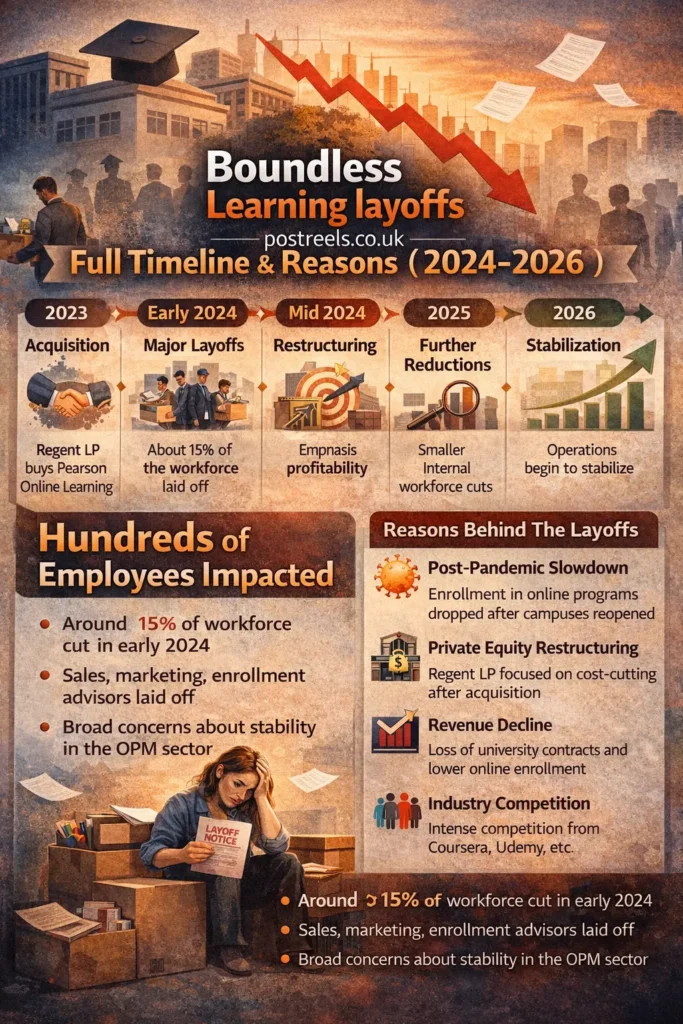
The first major wave of boundless learning layoffs began in early 2024. Reports indicated that around 15% of the workforce was cut during restructuring. Hundreds of employees across departments were affected.
Departments impacted included:
- Sales and marketing teams
- Enrollment advisors
- Software development
- Support operations
- Administrative roles
Several employees shared that termination meetings were held virtually. System access was removed quickly after notification. This created strong social media reactions and raised concerns about communication transparency.
Smaller internal workforce adjustments reportedly continued into 2025 and 2026. These were described as strategic reorganization rather than mass layoffs. However, uncertainty remained among staff.
What Is the Full Timeline of Boundless Learning Layoffs (2024–2026)?
Below is a simplified timeline summarizing major developments.
| Year | Event | Impact |
|---|---|---|
| 2023 | Acquisition from Pearson by Regent LP | Transition to private equity ownership |
| Early 2024 | First major layoffs (approx. 15%) | Hundreds affected |
| Mid 2024 | Operational restructuring | Focus on profitability |
| 2025 | Smaller internal workforce reductions | Streamlined operations |
| 2026 | Stabilization phase | Emphasis on sustainable growth |
The most significant event remains the 2024 mass layoffs. That period shaped employee morale and public perception.
Why Did Boundless Learning Lay Off Employees?
The reasons behind boundless learning layoffs are layered. No single factor caused the job cuts. Instead, several industry-wide and internal forces converged.
1. Post-Pandemic Edtech Slowdown
During the pandemic, online education demand surged. Universities rushed to expand digital programs. OPM companies scaled rapidly.
After reopening, enrollment growth slowed. Students returned to in-person learning. Marketing costs remained high. Revenue growth flattened.
This mismatch led to economic pressure.
2. Private Equity Restructuring by Regent LP
Private equity firms often streamline operations. The goal is efficiency and profitability.
After the acquisition, Boundless Learning shifted strategy. Leadership focused on:
- Cutting operational costs
- Prioritizing profitable programs
- Reducing underperforming partnerships
Layoffs are common in these restructuring phases.
3. Revenue and Client Retention Challenges
Some university contracts were reportedly not renewed. OPM contracts are often long-term revenue anchors. Losing even a few major partnerships can create financial strain.
4. Industry Competition
The edtech market is crowded. Companies like Coursera, Udemy, and internal university teams compete for digital education contracts.
This increased pressure on pricing and margins.
What Are the Dominant Reasons Behind Boundless Learning Layoffs According to Industry Analysis?
Understanding the real drivers behind boundless learning layoffs requires looking beyond a single event. Most ranking content and industry commentary point to five major topic clusters that explain the workforce reduction strategy.
These reasons are tied to economic pressures, organizational restructuring, and the broader industry-wide edtech downturn. When analyzed together, they show a pattern seen across many online learning company layoffs in the U.S.
Let’s break them down in detail.
Did the Post-Pandemic EdTech Market Crash Trigger Boundless Learning Layoffs?
Yes, the post-pandemic edtech decline played a major role in boundless learning layoffs.
During COVID, digital learning platforms experienced explosive growth. Universities rushed to launch online programs. Enrollment in remote degrees increased rapidly. Companies in the EdTech sector hired aggressively to meet demand.
However, once campuses reopened:
- Online learning demand dropped
- Hybrid education models stabilized
- Universities reduced marketing budgets for online degrees
This created declining demand for online education services. Growth projections made during the pandemic became unsustainable. Many edtech layoffs in 2024 followed the same pattern.
From an industry perspective, this shift was not unique. It affected the entire OPM industry and the digital learning platforms ecosystem.
How Did Revenue Decline and Client Loss Contribute to Boundless Learning Job Cuts?
Revenue pressure is frequently cited as a core factor behind boundless learning job cuts and workforce reduction.
Several indicators reported across industry discussions include:
- Reduced university enrollment growth
- Contract renegotiations with academic partners
- Possible revenue decline estimates near 20–25% in certain program segments
- Loss or restructuring of higher education partnerships
When Online Program Management providers lose major university clients, financial gaps appear quickly. Long-term contracts are the backbone of the OPM business model. Even a few non-renewals can trigger cost-cutting measures.
Institutions like Maryville University and Ohio University represent the type of strategic partnerships that OPM firms depend on. Any shift in these relationships can influence hiring, staffing, and operational structure.
What Role Did Private Equity Restructuring (Pearson to Regent LP) Play?
The transition from Pearson Online Learning Services to new ownership under Regent LP marked a turning point.
Private equity restructuring layoffs are typically driven by:
- Leaner operations
- Profit-focused restructuring
- Streamlining operational layers
- Eliminating redundant roles
After the acquisition, Boundless Learning reportedly prioritized financial sustainability over rapid expansion. This often leads to organizational restructuring and a workforce downsizing edtech approach.
Instead of growth-at-all-costs, the company shifted toward:
- Profitable academic programs only
- Cost efficiency
- Operational scalability
This aligns with standard post-acquisition restructuring strategies seen across the U.S. education technology market.
Did Industry Competition Increase Pressure on Boundless Learning Workforce Reduction?
Competition in the digital learning platforms space intensified significantly.
Major competitors frequently mentioned in SERP analysis include:
- Coursera
- Udemy
- Khan Academy
- Google Classroom
These platforms offer scalable, lower-cost alternatives to traditional OPM services. Universities are increasingly exploring in-house digital education models or hybrid solutions.
This competition creates:
- Pricing pressure
- Client retention challenges
- Reduced margins for OPM providers
As a result, online learning company layoffs became more common across the sector.
Was Strategic Reorganization and Downsizing Part of the Workforce Reduction Strategy?
Yes. Strategic reorganization is one of the most repeated NLP phrases across ranking pages discussing boundless learning restructuring.
Key restructuring signals included:
- Reduced hiring pipelines
- Unfilled positions
- Department consolidation
- Streamlined operations
Instead of continuous expansion, the company shifted toward a workforce reduction strategy focused on efficiency. This is a typical response during economic slowdowns and restructuring cycles.
What Do Social Media and Employee Reviews Reveal About Boundless Learning Layoffs?
Public sentiment adds real-world context that many articles ignore.
Across employee forums, Reddit threads, and review platforms, recurring themes include:
- Sudden layoffs and an abrupt termination process
- Lack of transparency from leadership
- Layoffs without severance concerns
- Culture of uncertainty post-acquisition
Some employee reviews also mention layoffs during the transition from Pearson ownership. Others highlight morale decline and talent loss after restructuring.
From a workplace dynamics perspective, this is consistent with post-acquisition restructuring environments where organizational identity shifts quickly.
How Do Boundless Learning Layoffs Compare to Other EdTech Layoffs in 2024–2026?
One major content gap in SERPs is the lack of comparative analysis.
The reality is that boundless learning layoffs align with a larger wave of edtech layoffs 2024 and beyond.
Industry patterns include:
- Workforce downsizing across OPM companies
- Budget tightening in digital education startups
- Shift toward AI-driven learning tools
- Consolidation in the EdTech sector
Compared to smaller startups, OPM providers face additional risk due to long sales cycles and heavy operational costs tied to university partnerships.
What Are the Hidden OPM Industry Risks Most Articles Ignore?
This is a high-authority angle missing from most ranking content.
The Online Program Management model carries structural risks:
- Revenue tied to enrollment cycles
- High marketing acquisition costs
- Dependence on long-term university contracts
- Regulatory scrutiny in U.S. higher education
If enrollment slows or contracts end, companies must quickly adjust staffing levels. This makes OPM industry layoffs more likely during market corrections.
In simple terms, the business model is scalable during growth but vulnerable during downturns.
How Does This Case Reflect a Broader Industry-Wide EdTech Downturn?
The boundless learning layoffs should be viewed as part of a systemic shift, not an isolated event.
Key macro factors include:
- Declining demand for online education after pandemic peak
- Economic pressures on education budgets
- Increased competition from self-paced learning platforms
- Institutional move toward internal digital infrastructure
This industry-wide edtech downturn forced many companies to adopt cost-cutting measures and organizational restructuring strategies to survive long-term.
How Many Employees Were Affected by Boundless Learning Layoffs?
Public estimates suggest hundreds of employees were impacted during the main 2024 round. Exact numbers vary because companies do not always disclose full workforce data.
In many edtech layoffs across the U.S., reductions range from 10% to 20% of staff. Boundless Learning appears to fall within that range during its largest workforce reduction.
For employees in states like California, Texas, and Ohio, job cuts also triggered concerns about WARN Act notifications. However, details on compliance varied by location and employee count.
How Did Employees React to Boundless Learning Layoffs?
Employee sentiment played a major role in shaping public discussion.
Common themes included:
- Abrupt termination meetings
- Concerns about severance packages
- Reduced morale among the remaining staff
- Fear of ongoing layoffs
In many restructuring cases, the biggest impact is not just job loss. It is uncertainty. When communication feels unclear, trust declines.
From a real-world HR perspective, this is common in rapid corporate transitions. I have seen similar patterns in other private equity acquisitions. Teams struggle to adapt to new performance metrics and tighter cost controls.
Is Boundless Learning Shutting Down?
No. Boundless Learning has not announced closure. The company continues to operate and support online university programs.
After workforce downsizing, leadership emphasized financial sustainability and operational focus. This shift is typical when companies move from growth-at-all-costs to profitability.
Stabilization in 2026 suggests the company aims to operate leaner rather than expand aggressively.
How Do Boundless Learning Layoffs Compare to Other Edtech Layoffs?
The edtech downturn was not isolated. Several U.S.-based companies reduced staff after pandemic growth cooled.
Industry-wide trends included:
- Hiring freezes
- Marketing budget cuts
- Mergers and acquisitions
- Consolidation in the OPM sector
Companies such as 2U and other digital education providers also faced financial restructuring pressure.
This suggests boundless learning layoffs reflect a broader structural shift, not a single-company crisis.
What Risks Exist in the OPM Business Model?
This is where most articles fall short.
The OPM model depends heavily on:
- Long-term university contracts
- Enrollment growth projections
- Revenue sharing agreements
If student enrollment declines, revenue drops. If universities decide to build internal digital teams, contracts may end.
Private equity ownership adds another layer. Investors often seek faster returns. That creates performance targets.
From an industry analysis perspective, OPM companies must balance:
- Aggressive growth
- Stable partnerships
- Cost management
Failing to balance these can lead to workforce reduction.
What Does This Mean for University Partners?
Universities using OPM services may face:
- Transition delays
- Staffing changes in program support
- Marketing strategy shifts
However, layoffs do not automatically mean service collapse. Often, companies consolidate teams while maintaining key accounts.
University administrators typically review contingency plans during such transitions.
What Can Employees and Job Seekers Learn from Boundless Learning Layoffs?
If you work in edtech or higher education technology, here are key lessons:
- Watch revenue diversification.
- Monitor acquisition news closely.
- Understand private equity strategies.
- Build adaptable digital skills.
Roles in instructional design, AI-supported learning systems, and enrollment analytics remain in demand.
Career resilience matters in volatile sectors.
Key Takeaways from Boundless Learning Layoffs (2024–2026)
- The largest layoffs occurred in 2024.
- Approximately 15% of staff were affected.
- Private equity restructuring played a central role.
- The post-pandemic edtech slowdown reduced revenue growth.
- The company continues operating in 2026.
- Industry-wide layoffs reflect structural change, not collapse.
Frequently Asked Questions About Boundless Learning Layoffs
Why did Boundless Learning lay off employees?
Due to private equity restructuring, post-pandemic enrollment decline, and cost-cutting measures to improve profitability.
How many employees were affected by boundless learning layoffs?
Reports suggest roughly 15% of the workforce, equating to hundreds of employees.
Is Boundless Learning still operating?
Yes. The company continues providing OPM services to university partners.
Were severance packages provided?
Severance details varied by role and tenure, according to employee reports.
Are more layoffs expected?
No major announcements have been made, but restructuring environments can evolve.
Conclusion: What the Boundless Learning Layoffs Really Signal
The story of boundless learning layoffs is not just about job cuts. It reflects a larger shift in the edtech and Online Program Management sector.
The pandemic accelerated digital learning growth. The correction phase forced companies to prioritize efficiency over expansion.
Boundless Learning represents a case study in how private equity ownership, enrollment trends, and market competition intersect.
For universities, it is a reminder to diversify digital strategies. For employees, it highlights the need for adaptable skills. For investors, it underscores the risk tied to enrollment-driven revenue models.
The industry is not disappearing. It is maturing.
Companies that survive this phase will likely emerge leaner, more focused, and more sustainable.