

Have you ever tried to read a menu in a dimly lit restaurant and found yourself holding it further away just to make the words clear? That moment is a direct experience with your eye’s near point. To understand why this matters, we need to list several activities during which the near point is important and see how they impact our daily lives. The near point is simply the closest distance at which your eye can focus sharply on an object. For young adults with healthy vision, this is usually about 25 centimeters (or 10 inches) from the eye.
When this ability works well, we rarely notice it. We shift our gaze from the horizon to our watch and back again without a second thought. However, as we age or experience eye strain, the near point recedes, making close-up tasks more difficult. This biological function is critical for almost everything we do within arm’s reach. From checking a smartphone notification to threading a needle, our eyes are constantly adjusting. By exploring the specific activities that rely on this function, we can better appreciate the complexity of human vision and understand when it might be time to see a specialist.
Why is it necessary to list several activities during which the near point is important?
Understanding the scope of near point activities helps us realize just how much we rely on this visual mechanism. We often take clear vision for granted until it starts to fade. When we list several activities during which the near point is important, we are essentially cataloging the tasks that require accommodation—the process where the eye’s lens changes shape to focus on near objects.
This list serves as a diagnostic tool for many people. If you struggle with the items on this list, it might indicate presbyopia (age-related farsightedness) or other refractive errors. Recognizing these activities can also help parents identify vision issues in children who might be struggling in school but don’t know how to articulate the problem. It brings awareness to visual ergonomics, reminding us to take breaks and maintain proper distances to prevent digital eye strain.
For example, a student might complain of headaches not because they are dehydrated, but because their near point is struggling to maintain focus on their textbooks for hours. A professional might feel fatigue after a long day, not from the mental workload, but from the visual demand of focusing on a screen. Identifying these activities is the first step toward better eye health management.
How does reading books and magazines rely on the near point?
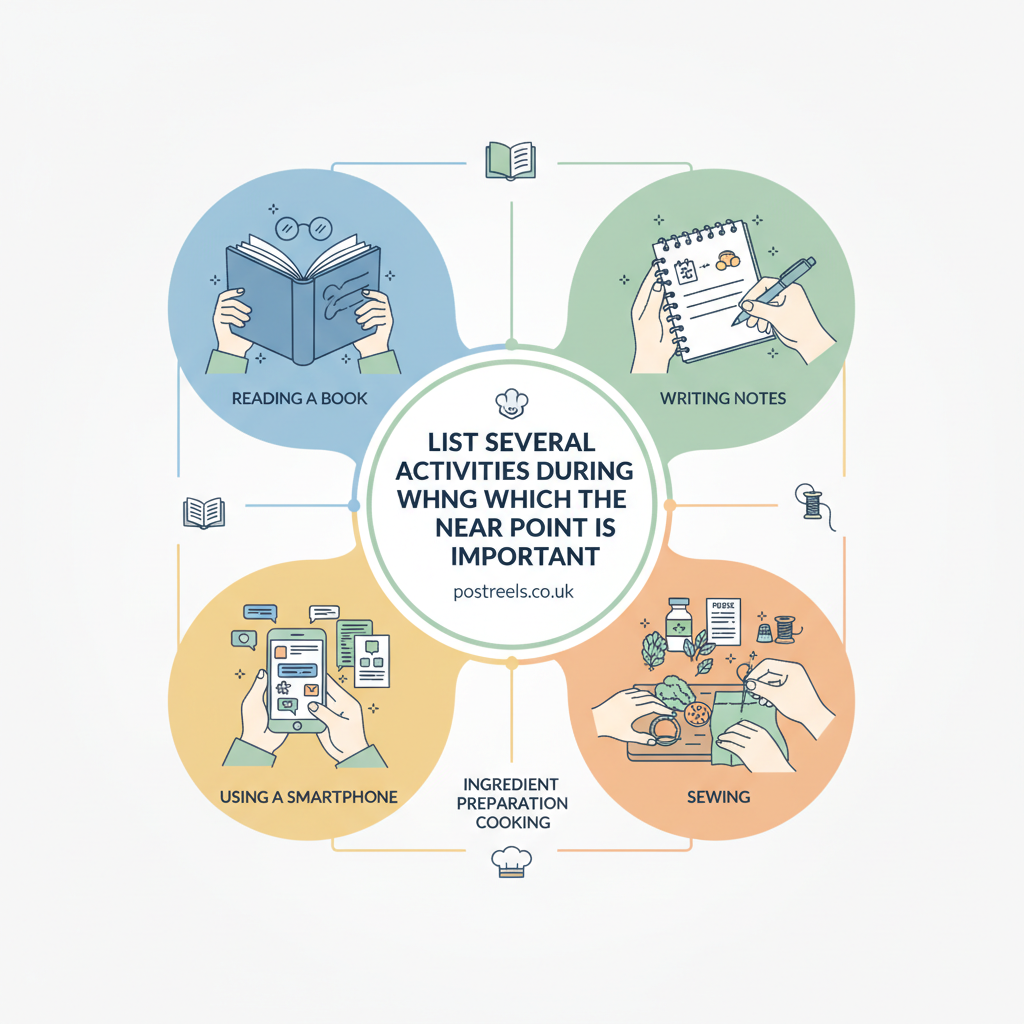
Reading is perhaps the most classic example of a near-point task. When you settle down with a good book or a magazine, you are typically holding the material between 30 and 40 centimeters from your face. This falls squarely within the demand zone for near vision. Your eyes must converge (turn inward slightly) and accommodate (thicken the lens) to keep the text sharp.
If your near point has receded—meaning you can’t focus on things close up—the text will appear blurry. You might find yourself pushing the book away to find that “sweet spot” where the letters become clear again. This is often the first sign of presbyopia in adults over 40. The sustained effort required to keep focus during a long reading session can lead to eye strain if your near point capabilities aren’t up to the task.
Consider a local librarian in Chicago who spends her entire day sorting books and reading spine labels. If her near point isn’t functioning correctly, she isn’t just inconvenienced; she may suffer from headaches and dizziness. Reading requires continuous, uninterrupted engagement of the near point, making it a high-endurance activity for your eyes.
Is using a smartphone one of the activities where the near point is critical?
Absolutely. In the modern era, smartphone usage is the dominant near-point activity. What makes this distinct from reading a book is the distance. Research shows that people tend to hold mobile phones closer to their faces than printed materials—often as close as 20 to 30 centimeters. This places an even higher demand on the eye’s focusing system.
When you scroll through social media, read emails, or play games on your phone, your eyes are locked into a very short focal distance. This intense demand is a major contributor to Computer Vision Syndrome. If we list several activities during which the near point is important, smartphone use would likely top the chart for frequency and duration in the 21st century.
Think about a teenager in Seattle taking the bus to school. They are likely glued to their phone for the entire 30-minute ride. Their eyes are working overtime to maintain that near focus while the bus vibrates and the lighting changes. This dynamic environment forces the near point to constantly readjust, which is significantly more taxing than reading in a static chair.
Does writing and note-taking require near-point focus?
Writing, whether with a pen and paper or a stylus on a tablet, is an intricate motor task guided by vision. You need to see the tip of the pen and the line you are creating with high precision. This typically happens at a distance similar to reading, roughly 30 to 40 centimeters.
If you cannot focus clearly at this distance, your handwriting may become messy, or you might struggle to write in a straight line. For students, this is critical. A child who has an undiagnosed issue with their near point might write slowly or avoid homework because the act of focusing on the page is physically uncomfortable.
Imagine an architect in New York sketching initial drafts for a new building. The precision required to draw straight lines and write small measurements necessitates a sharp near point. If their vision blurs, errors creep in. Writing is a feedback loop: you write, you see what you wrote, and you adjust. Without a functioning near point, that loop is broken, leading to frustration and poor results.
Why is threading a needle or sewing a needlepoint activity?
Crafts and precision work like sewing, knitting, or threading a needle represent the end of near point demands. These tasks often require bringing objects even closer than reading distance to see fine details. Threading a needle, for instance, might require focusing at 15 to 20 centimeters.
This level of detail requires “high-resolution” vision that is only possible if the near point is functioning perfectly. If you have ever watched someone struggle to thread a needle, pulling it back and forth to find the focus, you are watching them search for their near point.
Consider a grandmother in Texas trying to mend a quilt. If her near point has receded due to age, this beloved hobby becomes a source of stress. She might need magnifiers or strong reading glasses to artificially bring her near point back to a usable range. These activities are less about duration and more about the absolute limit of how close the eye can focus.
How does applying makeup or shaving relate to the near point?
Personal grooming is a daily ritual that we often perform on autopilot, but it heavily relies on near vision. When you apply eyeliner or shave your face, you are looking in a mirror. While the mirror itself might be on the wall, you often lean in close, effectively halving the distance your eyes need to focus on to see the reflection of your own face in detail.
To apply mascara safely or shave without cutting yourself, you need precise depth perception and sharp focus. This is a classic scenario where we list several activities during which the near point is important. If you can’t focus up close, you might end up with uneven makeup or missed patches while shaving.
Think of a young professional preparing for a job interview. They need to look their best. If they are struggling to see their reflection clearly because they cannot focus at a short distance, it adds anxiety to their morning routine. Many people install magnifying mirrors in their bathrooms precisely to combat issues with their near point, effectively making the object appear larger so the eye doesn’t have to strain as much to see details.
Can we list several activities during which the near point is important for eating?
Eating is an overlooked visual task. While we don’t need microscopic vision to eat, we do need to see what is on our fork and where our mouth is. This activity happens within the “personal space” zone, roughly 30 centimeters from the eyes.
We inspect our food for bones, seeds, or imperfections before we take a bite. We also use near vision to cut food into appropriate sizes. While the visual demand is lower than threading a needle, it is still a near-point activity.
Imagine dining at a dimly lit steakhouse. You rely on your near vision to cut your steak and ensure you aren’t eating a piece of gristle. If your near point is compromised, eating can become a messy or tentative affair. You might knock over a glass because your depth perception at close range is off, or you might struggle to manage utensils gracefully.
Do card games and board games require near-point vision?
Social activities often revolve around a table, placing them squarely in the near-vision range. Playing cards, board games, or doing puzzles requires constant shifting of focus from the cards in your hand to the board on the table.
In a game of poker, you need to quickly glance at your cards without giving away your hand. This requires instant accommodation. If you have to hold your cards at arm’s length to see if you have a heart or a diamond, you are at a distinct disadvantage.
Think about a family game night in Ohio. Everyone is gathered around a Monopoly board. You need to read the small print on the Chance cards and count the spaces for your token. This is a dynamic near-point environment. Fatigue sets in quickly if your eyes struggle to maintain that 40-centimeter focus for an hour or two.
Is cooking and food preparation on the list?
Cooking is a multi-step task, but the most dangerous parts happen up close. Chopping vegetables, measuring spices, and reading recipes on a tablet or card are all near-point activities.
When you are slicing an onion, your eyes are focused on the knife blade, which is perhaps 30 to 40 centimeters away. Accuracy here is a safety issue. If your near focus blurs, you risk cutting your finger. Reading the small measurement lines on a glass measuring cup also requires sharp near vision.
A home baker in Vermont measuring flour for a cake needs to see exactly when the flour hits the line. If they can’t focus, the recipe fails. Cooking requires a functional near point to ensure both safety and culinary success. It involves rapid changes in focus, from the cutting board to the stove dial, all within the near-to-intermediate range.
How does checking a smartwatch utilize the near point?
Wearable technology has introduced a new, ultra-close visual task. Smartwatches have small screens with tiny text. To read a notification, check your heart rate, or see the time, you typically bring your wrist up to chest level.
This distance is often shorter than holding a phone. You might glance at your watch from 20 centimeters away. Because the text is small, the demand on the eye’s focusing system is intense but brief.
For a runner checking their pace mid-stride, this is a complex visual task. The head is moving, the arm is moving, and the eyes must lock onto a small, near target instantly. If we list several activities during which the near point is important, interacting with wearables is a growing category that demands high elasticity from our eye lenses.
Why is medication management critical for near-point vision?
One of the most vital health-related tasks is managing medication. Pill bottles are notorious for having tiny print. Reading dosage instructions, checking expiration dates, and distinguishing between different pills are all critical near-point tasks.
This is a major concern for the elderly population, whose near point has naturally receded. If they cannot focus on the small print, they risk taking the wrong medication or the wrong dose.
Imagine a senior citizen in Florida organizing their weekly pill sorter. They need to distinguish the white heart pill from the white round pill. This requires sharp, close-up vision. Mistakes here have serious consequences, making this perhaps the most “important” activity on our list in terms of health and safety.
Summary of Near Point Activities
| Activity | Typical Distance | Visual Demand |
|---|---|---|
| Smartphones | 20-30 cm | Very High |
| Threading Needle | 15-20 cm | Extreme |
| Reading Books | 30-40 cm | High |
| Eating | 30-40 cm | Low-Medium |
| Computer Work | 50-60 cm | Medium-High |
| Applying Makeup | 15-25 cm | High |
Key Takeaways
- Daily Reliance: We use our near point constantly, often without realizing it, for tasks ranging from safety (cooking, medication) to leisure (reading, gaming).
- Distance Matters: Different activities require different focal distances. Smartphone use is closer to reading a book, placing more strain on the eyes.
- Age Factor: The ability to perform these tasks naturally declines with age as the lens stiffens (presbyopia), making near-point activities harder.
- Safety Implications: Poor near vision can lead to accidents in the kitchen or mistakes with medication.
- Digital Strain: Modern life has increased the load on our near vision due to the prevalence of screens and small devices.
FAQ
Q: What exactly is the near point of the eye?
A: The near point is the closest distance at which your eye can focus clearly on an object. For a young adult with normal vision, this is typically about 25 cm (10 inches), but it moves further away as we age.
Q: Why do I have to hold things further away to see them as I get older?
A: This is due to a condition called presbyopia. As you age, the lens of your eye becomes less flexible, making it harder to change shape and focus on close objects. This causes your near point to recede (move further away).
Q: Can eye exercises improve my near point?
A: While some exercises can help with convergence insufficiency (getting eyes to work together), they generally cannot reverse the hardening of the lens that causes presbyopia. However, taking breaks and focusing on distant objects can reduce eye strain.
Q: Is using a computer considered a near-point activity?
A: Technically, computer use is often considered “intermediate” vision (around 50-60 cm), but it is close enough that it relies heavily on the same accommodation muscles. Many people include it when they list several activities during which the near point is important because the symptoms of strain are similar.
Q: How can I help my eyes during these activities?
A: Follow the 20-20-20 rule: Every 20 minutes, look at something 20 feet away for 20 seconds. Ensure you have good lighting, and if you are over 40, consult an eye doctor about reading glasses or progressive lenses.