

A memorandum to cabinet is one of the most powerful documents in government. It shapes laws, launches national programs, and drives billion-dollar spending decisions. Yet most people have never heard of it. If you work in public policy, study government, or just want to understand how big decisions get made, this guide is for you.
We will walk through what a memorandum to cabinet is, how it works, what it looks like, and why it matters — all in plain English.
What Is a Memorandum to Cabinet, Exactly?
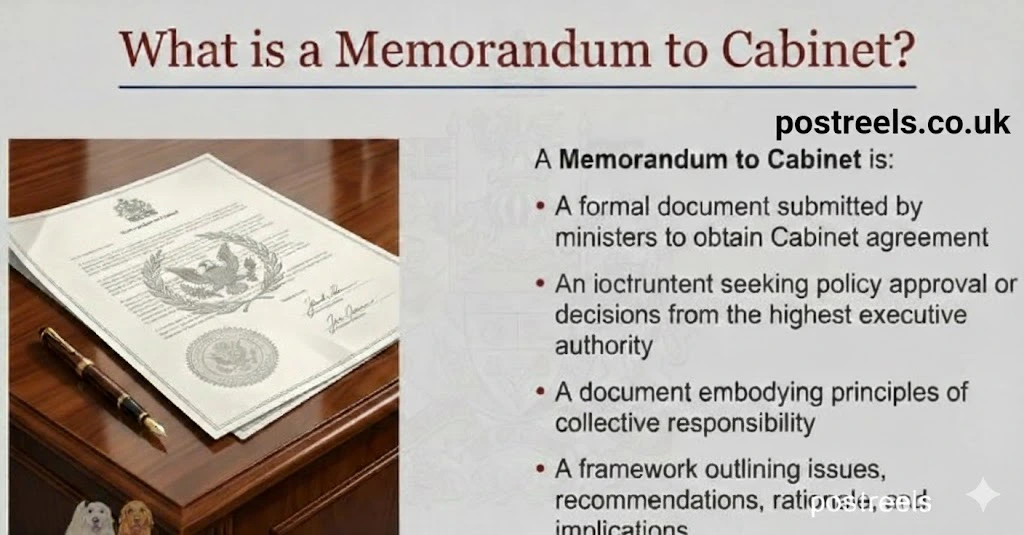
A memorandum to cabinet (often called an MC) is a formal document that a government minister submits to the Cabinet or one of its committees. The goal is to get a decision made at the highest level of government.
Think of it as a formal request from a minister to the group of senior ministers who run the country. The MC explains a problem, lays out options, and asks Cabinet to choose a direction.
Without this document, a minister cannot move forward with major policy changes, new laws, or large spending programs. It is the gateway to government action.
Here is what makes an MC different from a regular memo:
- It goes to Cabinet — not just a department head or deputy minister
- It requires legal and financial review before submission
- It is classified as a Cabinet confidence, meaning it is secret
- It triggers a formal decision that the entire government must follow
In the United States context, the equivalent process often happens through presidential memoranda, executive orders, or formal policy submissions to cabinet-level departments. While the terminology differs, the underlying logic is the same: senior officials need a documented, reviewed, and approved process before acting on major policy.
Why Does a Memorandum to Cabinet Exist?
Governments deal with complex, high-stakes problems every day. Without a formal process, decisions could be rushed, poorly analyzed, or inconsistent with the law.
The memorandum to cabinet exists to solve that problem. It forces decision-makers to:
✔ Clearly define the issue at hand ✔ Show they considered multiple options ✔ Assess financial, legal, and social impacts ✔ Get input from multiple departments and central agencies ✔ Document the rationale for the chosen path
This creates accountability. If a policy goes wrong later, the MC becomes part of the record. Governments, auditors, and future officials can look back and understand why a decision was made.
It also protects ministers. A well-written MC shows that due diligence was done. It demonstrates that the decision was based on evidence, not guesswork.
What Is a Memorandum to Cabinet in Canada?
In Canada, the memorandum to cabinet is a core feature of how the federal government operates. The Privy Council Office (PCO) governs the process and provides drafting guidance for federal departments.
Canada’s parliamentary system is based on the Westminster model. Cabinet is the executive decision-making body. Ministers are collectively responsible for government decisions. The MC is the primary tool for bringing policy questions to that collective.
How Does the Canadian MC Process Work?
The process in Canada typically follows these stages:
- A department identifies a policy issue or legislative need
- The sponsoring minister agrees to champion the initiative
- Policy analysts draft the MC with input from legal, financial, and program experts
- Central agencies — including the PCO, Treasury Board, Finance Canada, and Justice — review the draft
- The MC is submitted to the relevant Cabinet committee
- Cabinet discusses and decides
- If approved, implementation begins — often through a Treasury Board submission for funding
This process can take months. For major initiatives, the consultation phase alone may stretch over a year.
What Is Cabinet Confidence?
Once submitted, a memorandum to cabinet becomes a Cabinet confidence. This means it is protected from public disclosure. Even under Access to Information requests, MCs are usually withheld in full.
The reasoning is straightforward: if Cabinet deliberations were public, ministers could not speak freely. The protection encourages honest debate and candid advice.
What Does a Memorandum to Cabinet Look Like? Structure Explained
A standard memorandum to cabinet in Canada has two main parts: the Ministerial Recommendations section and the Annexes. Here is a breakdown of each.
Part 1: The Ministerial Recommendations (MR)
This is the core of the document. It contains the following sections:
| Section | Purpose |
|---|---|
| Title | Short, descriptive name tied to government priorities |
| Issue | One sentence framing the decision Cabinet must make |
| Recommendations | The specific approval the minister is seeking |
| Rationale | Why action is needed and why now |
| Proposed Approach and Options | Full analysis of 2–3 alternatives with pros, cons, and risks |
| Due Diligence | Financial and HR attestation from the Chief Financial Officer |
The Issue section is deceptively hard to write. It must frame the problem in a single, clear question. If the issue statement is vague or too broad, the rest of the document suffers.
The Recommendations section must be precise. Cabinet does not like ambiguity. The minister lays out exactly what approval is being sought — no more, no less.
The Proposed Approach and Options section is where most of the analysis lives. A good MC does not just present the minister’s preferred option. It honestly lays out alternatives, including the risks of each. Cabinet members ask tough questions. A minister who cannot defend why they rejected Option B will have a hard time at the committee table.
Part 2: The Annexes
Annexes provide supporting analysis that would clutter the main document. Common annexes include:
- Implementation Plan — key milestones, timelines, and expected results
- Communications Plan — how the government will announce and explain the decision
- Gender-Based Analysis Plus (GBA+) — impacts on different groups, including women, Indigenous peoples, racialized communities, and others
- Official Languages Impact — effects on English and French communities
- Indigenous Consultation Summary — what consultation was done and what was heard
- Regulatory Impact Analysis — if the proposal involves regulations
- Environmental Assessment — if required under federal law
Each annex must be completed. Missing or superficial annexes are a red flag for central agency reviewers. They signal that due diligence was not done properly.
What Is a Memorandum to Cabinet Template and How Is It Used?
A memorandum to cabinet template provides the official structure that departments must follow. In Canada, the PCO publishes a Drafter’s Guide for public servants. The template sets out the required sections, the order they appear in, and the type of information each section must contain.
Why Templates Matter
Templates are not just bureaucratic formality. They serve a real purpose:
- They ensure that all MCs contain the same categories of information
- They make it easier for Cabinet members to read and compare submissions
- They prevent departments from omitting inconvenient analysis
- They speed up the review process because central agencies know where to find what they need
A first-time drafter who ignores the template risks having the MC sent back by PCO reviewers — often multiple times. Experienced policy analysts know that following the template closely, even when it feels rigid, saves time in the long run.
The “Slim MC” — A Faster Option
Not every policy question requires a full MC. For simpler decisions — where the answer is essentially yes or no — departments can submit a Slim MC. This is a shorter, more streamlined version of the document.
A Slim MC is appropriate when:
→ The issue is well-understood and uncontroversial → The financial implications are modest and already approved in principle → Consultation has already been completed at an earlier stage → Cabinet mainly needs to formally ratify what has already been agreed to
Using a Slim MC for a complex, contested issue is a mistake. Cabinet members and committee chairs can tell when a submission is undercooked.
What Are the Different Types of Cabinet Submissions?
A memorandum to cabinet is not the only kind of Cabinet submission. There are several related document types, each serving a different function.
| Document Type | Purpose |
|---|---|
| Memorandum to Cabinet (MC) | Seeks policy direction or program approval |
| Slim MC | Seeks a simple yes/no decision on a lower-complexity issue |
| Government Position (GP) | Responds to Private Members’ Business in Parliament |
| Government Response (GR) | Responds to a Parliamentary committee report |
| Treasury Board Submission | Seeks funding or management approvals after MC policy approval |
Understanding which document is needed — and when — is a core skill for any policy analyst working in the federal government.
What Is a Real-World Memorandum to Cabinet Example?
Because MCs are Cabinet confidences, real examples are rarely made public. However, governments do release some MCs over time through Access to Information processes or after the relevant decisions become public knowledge.
Here is a realistic hypothetical to illustrate how an MC works in practice.
Example: A New Federal Skills Training Program
Suppose the Minister of Employment wants to launch a new national apprenticeship program targeting young workers in manufacturing.
The Issue might read: “Should the Government of Canada establish a new federal apprenticeship incentive program to address skilled trades shortages in the manufacturing sector?”
The Recommendations section would ask Cabinet to:
- Approve the program in principle
- Authorize the department to work with provinces and territories on implementation
- Direct the department to return to Treasury Board for funding authority
The Proposed Approach would lay out three options:
- Option A: A federal-only program delivered directly to apprentices (fast, but risks overlapping with provincial programs)
- Option B: A cost-sharing arrangement with provinces (slower to negotiate, but more sustainable and avoids duplication)
- Option C: Status quo — no new federal program (risks worsening skilled trades shortages)
The MC would recommend Option B, with analysis explaining why A and C were rejected.
The GBA+ annex would examine how the program affects women in trades, Indigenous youth, newcomers, and rural workers.
This kind of document — with its structured analysis, honest trade-off discussion, and mandatory annexes — is what a real memorandum to cabinet looks like in practice.
What Are the Most Common Mistakes When Writing a Memorandum to Cabinet?
Even experienced policy analysts sometimes get MCs sent back for revision. Here are the most common mistakes — and how to avoid them.
Vague Issue Statements
The Issue section must be a single, specific question. “How should the government address climate change?” is not an issue statement. “Should the Government of Canada establish a new industrial carbon reduction incentive program for the steel sector?” is.
Presenting Only One Option
Cabinet expects a real choice. Presenting one genuine option and two obviously bad alternatives does not fool anyone. Options must be realistic and honestly analyzed.
Underestimating Consultation Requirements
Departments often underestimate how much consultation is needed before an MC can be submitted. Indigenous consultation in particular requires meaningful engagement — not just a phone call or email. Inadequate consultation is one of the most common reasons MCs are delayed.
Ignoring GBA+ Early
GBA+ is not something you add at the end. It should shape the policy design from the start. Bolting it on at the last minute produces weak analysis that reviewers flag immediately.
Poor Communications Planning
Some drafters treat the Communications annex as an afterthought. But the Cabinet cares about how announcements will land. A strong communications plan shows that the department has thought through public reaction, media messaging, and stakeholder communication.
Key Takeaways
Here is a quick summary of everything covered in this article:
- A memorandum to cabinet is a formal document a minister submits to Cabinet seeking a policy decision
- It is used to get approval for new programs, legislation, regulatory changes, or spending initiatives
- In Canada, the PCO oversees the MC process and provides a Drafter’s Guide for public servants
- A standard MC has two parts: Ministerial Recommendations and Annexes
- Common annexes include the Implementation Plan, GBA+, Communications Plan, and Indigenous Consultation Summary
- A Slim MC is a shorter version for simpler, lower-stakes decisions
- MCs are Cabinet confidences — they are secret and protected from public disclosure
- Common mistakes include vague issue statements, weak options analysis, and inadequate consultation
Frequently Asked Questions (FAQs)
What is the purpose of a memorandum to cabinet?
The purpose of a memorandum to cabinet is to bring a policy issue to the attention of Cabinet and request a formal decision. It provides analysis, options, and a ministerial recommendation so that Cabinet can make an informed choice.
Who writes a memorandum to cabinet?
Policy analysts and program officers within a federal department write the MC, usually with input from legal counsel, financial officers, and communications staff. The sponsoring minister reviews and signs off before submission.
How long is a memorandum to cabinet?
A full MC typically runs 15–30 pages, including all annexes. A Slim MC may be as short as 3–5 pages. Length depends on the complexity of the issue.
Is a memorandum to cabinet public?
No. MCs are classified as Cabinet confidences. They are generally not released to the public, even through Access to Information requests, although some older MCs become available over time as the confidentiality protection expires.
What is the difference between a memorandum to cabinet and a Treasury Board submission?
An MC seeks policy direction or program approval from Cabinet. A Treasury Board Submission comes after Cabinet has approved the policy and seeks the funding or management authority to actually implement it.
How is a memorandum to cabinet different in Canada vs. other countries?
Canada uses the term memorandum to cabinet specifically within its Westminster-style parliamentary system. Australia and the UK have similar processes. The United States uses presidential memoranda and formal agency submissions to the National Security Council or Domestic Policy Council, which serve a comparable function.
What is GBA+, and why is it in a memorandum to cabinet?
GBA+ stands for Gender-Based Analysis Plus. It is a federal government requirement that policy proposals assess their impacts on diverse groups, including women, men, non-binary people, Indigenous peoples, racialized communities, persons with disabilities, and others. It is included in an MC annex to ensure that policies do not inadvertently harm marginalized groups.
Conclusion
A memorandum to cabinet is much more than a piece of paperwork. It is the formal mechanism through which governments make their biggest decisions. It forces rigorous analysis, structured debate, and collective accountability.
Whether you are a public servant drafting your first MC, a student studying public administration, or a citizen curious about how policy gets made, understanding this document gives you a window into the real machinery of government.
The process is demanding by design. Good policy takes time, consultation, honest analysis, and careful writing. The memorandum to the cabinet ensures that all of that work happens before a decision is made — not after.