

Imagine trying to build a complex Lego castle with five friends, but you’re all in different rooms and can’t talk to each other. You might end up with a castle that has three drawbridges and no towers. That chaotic scenario is exactly what traditional construction and engineering used to feel like. But today, the integrated design project approach is changing the game entirely.
An integrated design project is a collaborative method where architects, engineers, and builders work together from day one. Instead of passing blueprints back and forth like a hot potato, everyone sits at the same table to solve problems before they even happen. This holistic strategy saves money, cuts down on waste, and creates buildings that are smarter and greener. Whether you are a student tackling a mechanical engineering theory practice integration in design projects or a professional aiming for LEED certification, understanding this concept is your key to future success.
Key Takeaways
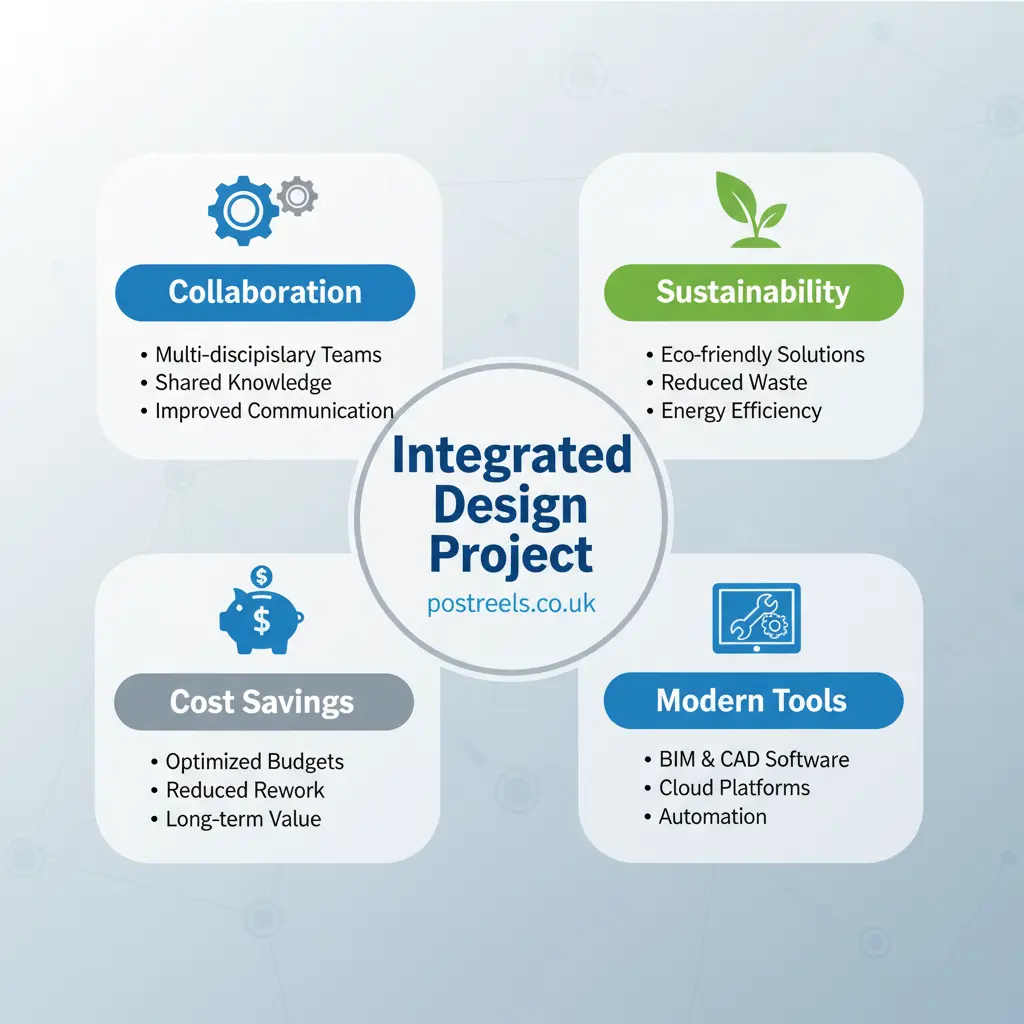
- Collaboration is King: Integrated design brings all experts together from the start.
- Cost Savings: Early problem-solving prevents expensive fixes later.
- Sustainability: It’s the best path to green certifications like LEED.
- Better Results: Projects are completed faster with fewer errors.
What Exactly Is an Integrated Design Project?
At its core, an integrated design project is about breaking down silos. In the old days, an architect would draw a building, hand it to an engineer to make it stand up, and then hand it to a contractor to build it. If the pipes clashed with the beams, nobody knew until it was too late.
The integrated design approach flips this script. It demands that the architect, structural engineers, mechanical engineers, and even the future building owners talk to each other right from the conceptual phase. This is often called a “whole building design” approach.
For students, this concept often appears in capstone courses. You might be asked to create an integrated design project report that details how different systems—like HVAC, electrical, and structural—work together seamlessly. It’s not just about drawing pretty pictures; it’s about making sure the building functions like a well-oiled machine.
How Did the Integrated Design Approach Evolve?
History is full of beautiful buildings, but the process of building them wasn’t always efficient. To understand where we are now, we have to look back.
The Master Builder Era
Centuries ago, one person—the Master Builder—knew everything. They designed the cathedral, engineered the arches, and managed the stone masons. There was no need for meetings because all the knowledge lived in one brain.
The Age of Specialization
As buildings got more complex with electricity and plumbing, we needed specialists. We have architects, electrical engineers, and HVAC experts. But they stopped talking to each other. This led to the “fragmented” design process, where errors became common and expensive.
The Return to Integration
In the late 20th century, as sustainability became crucial, the industry realized the old way wasn’t working. You can’t build a green building if the solar panel guy doesn’t talk to the roof guy. Thus, the integrated design project was born—a modern twist on the Master Builder concept, using a team instead of one person.
Why Is Collaboration the Secret Sauce?
You might wonder why sitting in meetings is better than just doing the work. The answer lies in the collaborative design process.
When you have a holistic design process, you catch mistakes on paper before they become mistakes in concrete. Imagine a structural engineer pointing out that moving a wall by two inches would save $10,000 in steel costs. That only happens if they are in the room during the design phase.
Benefits of Early Collaboration:
- Reduced Rework: Fewer “change orders” during construction.
- Faster Delivery: Decisions are made quicker.
- Innovation: A mechanical engineer might suggest a cooling system that changes the architectural shape for the better.
How Does This Apply to Mechanical Engineering?
For students and professionals in the field, mechanical engineering theory practice integration in design projects is a massive topic. It bridges the gap between textbooks and the real world.
In a university setting, an integrated design project example might involve designing a robotic arm. You can’t just design the mechanical linkages; you have to think about the electrical sensors and the software code simultaneously. If you ignore the electronics, your mechanical arm is just a paperweight.
This mirrors the industry. In a skyscraper, the mechanical engineer must work with the architect to fit massive air ducts into tight ceiling spaces without ruining the aesthetic.
What Are the Real-World Benefits of Sustainable Design?
One of the biggest drivers of the integrated design project is sustainability. You simply cannot achieve high-level green goals without it.
Sustainable design isn’t just about slapping solar panels on a roof. It’s about orientation, airflow, material selection, and water use.
Green Certifications
If you want a LEED Certification from the U.S. Green Building Council, integration is mandatory. The rigorous standards require that energy modeling happen early. You need environmental specialists to guide the team on energy-efficient and green materials.
Similarly, the International WELL Building Institute focuses on human health. Achieving their standards requires architects to work with health experts to design spaces that improve air quality and mental well-being.
| Benefit | Traditional Design | Integrated Design |
|---|---|---|
| Cost | Often over budget due to changes | Controlled through early planning |
| Sustainability | An afterthought (add-ons) | Built-in from the start |
| Timeline | Delays are common | Faster, smoother execution |
| Team Dynamic | Adversarial (Blame game) | Collaborative (Shared goals) |
Can You Show Me a US-Based Integrated Design Project Example?
Let’s look at a hypothetical but realistic example based on trends in Seattle, Washington. Let’s call it the “Emerald Tech Hub.”
The Goal: Build a net-zero energy office building.
The Process:
- Kick-off: The Project Managers, architects, and construction teams met before a single sketch was drawn.
- The Big Idea: The mechanical engineer suggested using rainwater harvesting to cool the building.
- The Pivot: The architect adjusted the roof angle to maximize rainwater collection and solar exposure.
- The Result: Because they talked early, they didn’t need expensive air conditioning units. The savings paid for the solar panels.
This is a classic integrated design project example. In a traditional process, the architect would have designed a flat roof, and the engineer would have just installed a massive AC unit, costing the owner millions more over time.
What Tools Power the Modern Design Workflow?
You can’t have a modern integrated design project without modern tech. We are way past pencil and paper.
BIM (Building Information Modeling)
This is the holy grail. BIM allows the entire team to work on a single 3D model. If the plumber moves a pipe in the software, the architect sees it instantly. This real-time update loop is critical for project optimization.
CAD (Computer-Aided Design)
While BIM is for the big picture, CAD is still used for detailed component design.
Simulation Software
Engineers use advanced software to simulate sunlight, wind, and energy use. This allows for environmental impact reduction strategies to be tested virtually before construction begins.
How Does Integrated Circuit Design Fit In?
While we often talk about buildings, the concept applies to electronics too. Think about integrated circuit design ic design flow and project based learning.
Designing a microchip is the ultimate integrated design project. You have billions of transistors that must work together. The “IC design flow” requires logic designers, circuit designers, and layout engineers to collaborate constantly. If one person fails, the whole chip fails. This is a perfect example of how multidisciplinary collaboration drives technology forward.
What Are the Main Challenges Teams Face?
It’s not all sunshine and rainbows. Implementing an integrated design project can be tough.
Common Hurdles:
- Ego: People don’t like being told what to do by someone from a different discipline.
- Contracts: Traditional contracts separate liability. Integrated projects require shared-risk and shared-reward contracts.
- Time: The early phase takes longer. Some clients get impatient and want to “start digging” before the design is ready.
The Solution:
Open communication throughout the project is the only fix. Strong leadership from Project Managers who understand stakeholder engagement is vital to keep the peace and keep the team focused on shared goals for sustainable results.
How Do We Fix the Content Gaps in Education?
Universities are rushing to catch up. The demand for integrated design project report writing skills is high.
Educational Resources Needed:
- Beginner-Friendly Guides: Students need simple breakdowns of complex workflows.
- Templates: Checklists for integrated design project milestones.
- Case Studies: More access to real-world data from firms.
If you are a student, look for courses that force you to work with students from other majors. That is the best preparation for the real world.
What Does the Future Hold for Integrated Design?
The future is automated and intelligent.
- AI and Generative Design: Artificial Intelligence will soon sit at the table. It will propose thousands of design options in seconds, optimizing for cost and carbon footprint instantly.
- IoT (Internet of Things): Buildings will provide feedback to the design team. Sensors will tell architects how people actually use the space, informing the next integrated design project.
- Smart Cities: We will move from integrated buildings to integrated cities, where power, water, and traffic systems all talk to each other.
Frequently Asked Questions (FAQs)
Q: What is the main goal of an integrated design project?
A: The main goal is to create high-performance, cost-effective, and sustainable projects by bringing all stakeholders together from the very beginning.
Q: Who is involved in an integrated design project?
A: Everyone! This includes Architects, Engineers (structural, mechanical, electrical), Project Managers, Construction Teams, Sustainability Experts, and the client.
Q: Is integrated design more expensive?
A: It might cost a bit more in the design phase, but it usually saves a massive amount of money during construction and operation, making it cost-effective design in the long run.
Q: Can this approach be used for small projects?
A: Absolutely. Even a small home renovation benefits when the builder and designer talk before the walls are opened up.
Q: How does this help with LEED certification?
A: LEED requires a holistic approach. An integrated design project ensures that sustainability points (like water savings or energy efficiency) are baked into the design, not just added on.
Conclusion
The integrated design project isn’t just a buzzword; it’s a necessity for our complex world. By fostering active participation of all professionals, we can build structures that are kinder to the planet and easier on the wallet.
Whether you are writing an integrated design project report for school or managing a multimillion-dollar site, remember: the best solutions come when we work together. The era of the lonely genius is over; the era of the brilliant team has begun.