


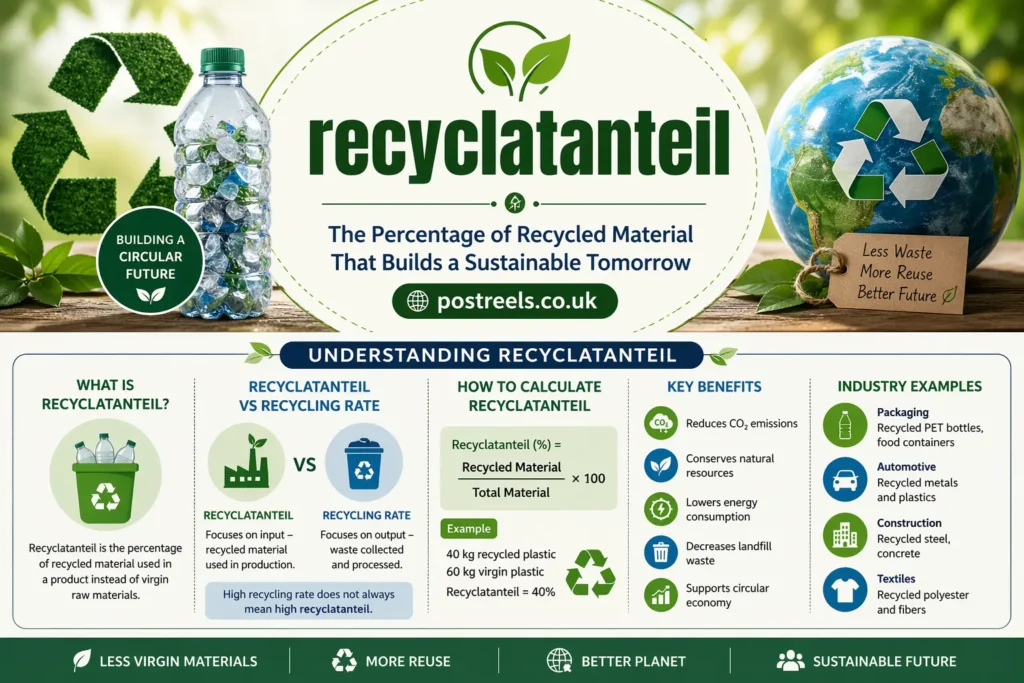
Understanding recyclatanteil is becoming essential for anyone interested in sustainability, packaging, or modern manufacturing. In simple terms, it refers to the percentage of recycled material used in a product. It focuses on what goes into production, not what gets recycled afterward. This makes it a key metric in the shift toward a circular economy, where materials are reused instead of wasted.
What is recyclatanteil and why does it matter today?
It measures the share of recycled content in a product. It tells us how much of a product comes from reused materials instead of new, virgin resources.
For example:
- A plastic bottle with 30% recycled PET has a recyclatanteil of 30%
- A cardboard box made from 80% recycled fibers has a recyclatanteil of 80%
This metric matters because:
- It reduces dependence on raw materials
- It lowers carbon emissions
- It supports sustainable manufacturing practices
Companies in the U.S. are now using it as part of ESG reporting and environmental goals.
How is it different from the recycling rate?
This is where many people get confused.
Key difference explained simply
| Metric | What it measures | Focus |
| Recycling rate | Waste collected and processed | Output |
| recyclatanteil | Recycled material used in products | Input |
Why this difference matters
A country can have a high recycling rate but still use very little recycled material in manufacturing.
That means:
- Waste is processed but not reused
- Materials still end up downcycled or exported
- Sustainability impact remains low
It focuses on actual reuse, which is why experts consider it more meaningful.
How do you calculate recyclatanteil in products?
The calculation is simple but often overlooked.
Example calculation
If a product contains:
- 40 kg recycled plastic
- 60 kg virgin plastic
Then:
- Total = 100 kg
- recyclatanteil = 40%
Measurement methods
- Weight-based calculation (most common)
- Volume-based calculation (used in liquids or packaging)
Why is recyclatanteil important for the circular economy?
It plays a direct role in closing the loop of materials.
Key contributions
- Replaces virgin raw materials
- Encourages the reuse of secondary raw materials
- Supports waste-to-resource transformation
- Improves resource efficiency
Without demand for recycled content, recycling systems fail. This is why it is considered a demand-side solution.
What industries rely heavily on recyclatanteil?
Different industries use it in different ways.
Major sectors
- Packaging: PET bottles, food containers
- Construction: recycled steel, concrete
- Automotive: recycled metals and plastics
- Textiles: recycled polyester and fibers
- Electronics: recovered metals
Real-world examples
- Coca-Cola uses recycled PET in bottles across U.S. markets
- Adidas produces shoes using recycled ocean plastic
- Tesla incorporates recycled metals in batteries and vehicles
These examples show how it is shaping modern production.
What are the environmental benefits of high recyclatanteil?
Higher leads to measurable environmental gains.
Key benefits
- Reduced CO₂ emissions
- Lower energy consumption
- Less landfill waste
- Conservation of natural resources
Data snapshot
| Material | Energy savings with recycled content |
| Aluminum | Up to 95% |
| Steel | Around 60–70% |
| Plastic | 30–80% |
| Paper | 40% |
This makes it a critical sustainability metric.
What challenges limit recyclatanteil in real-world use?
Despite its benefits, it faces several barriers.
Common challenges
- Contamination of recycled materials
- Quality differences compared to virgin materials
- Limited supply of high-grade recyclates
- Regulatory restrictions for food-grade plastics
Why are plastics the hardest
Plastic recycling is complex due to:
- Mixed material types
- Safety standards
- Degradation during recycling
In contrast, metals and glass perform much better.
What are the latest regulations and policies?
Governments are pushing for higher targets through laws.
Key policy trends
- Minimum recycled content requirements
- Plastic packaging regulations
- Extended producer responsibility (EPR)
U.S. perspective
States like California are leading with:
- Mandatory recycled content in plastic bottles
- Strict reporting standards
Global influence
The European Union is setting aggressive targets for recycled content in packaging, influencing global markets.
How can businesses increase it effectively?
Companies can take practical steps for improvements.
Proven strategies
- Design products for recyclability
- Use post-consumer recyclate (PCR)
- Partner with recycling suppliers
- Invest in material innovation
Smart business practices
- Track material lifecycle data
- Align with ESG compliance standards
- Educate consumers about recycling
How can consumers identify products?
Consumers play a key role in driving demand.
What to look for
- Labels showing recycled content percentage
- Certifications and eco-labels
- Transparent sustainability reports
Simple buying tips
- Choose products with clear recycled content claims
- Support brands using sustainable materials
- Avoid single-use products when possible
What does the future of recyclatanteil look like?
The future is driven by innovation and policy.
Emerging trends
- Advanced recycling technologies
- AI-driven waste sorting
- Bio-based and hybrid materials
- Stronger global regulations
Market direction
Demand for recycled materials is rising. Companies that invest early in it will gain a competitive edge.
Key takeaways
- recyclatanteil measures recycled content in products
- It is different from the recycling rate
- It supports the circular economy
- It reduces carbon footprint and waste
- It is becoming a regulatory requirement
Conclusion
It is more than just a technical term. It is a powerful indicator of how sustainable a product truly is. While recycling rates show effort, recyclatanteil shows real impact. As industries move toward circular systems, this metric will become even more important.
For businesses, it offers a way to meet ESG goals and reduce environmental impact. For consumers, it provides a clear signal of responsible products. And for the planet, it represents a shift toward smarter use of resources.
FAQs
What does recyclatanteil mean in simple terms?
Recyclatanteil is the percentage of recycled material used in making a product instead of new raw materials.
Why is the recycling rate more important?
Because it shows actual reuse in production, not just how much waste is collected or processed.
Which materials are usually the most recyclable?
Metals like aluminum and steel, along with glass, often achieve a higher recyclability due to easier recycling processes.
How can companies increase their recycling rate?
By using post-consumer recyclate, improving product design, and sourcing high-quality recycled materials.
Is recyclatanteil relevant for everyday consumers?
Yes, it helps consumers choose products that reduce environmental impact and support sustainable manufacturing.